Tenant Ownership as a First-Class Billing Primitive
Multi-tenant billing is often treated as a database design problem.
In reality, it is much broader than that.
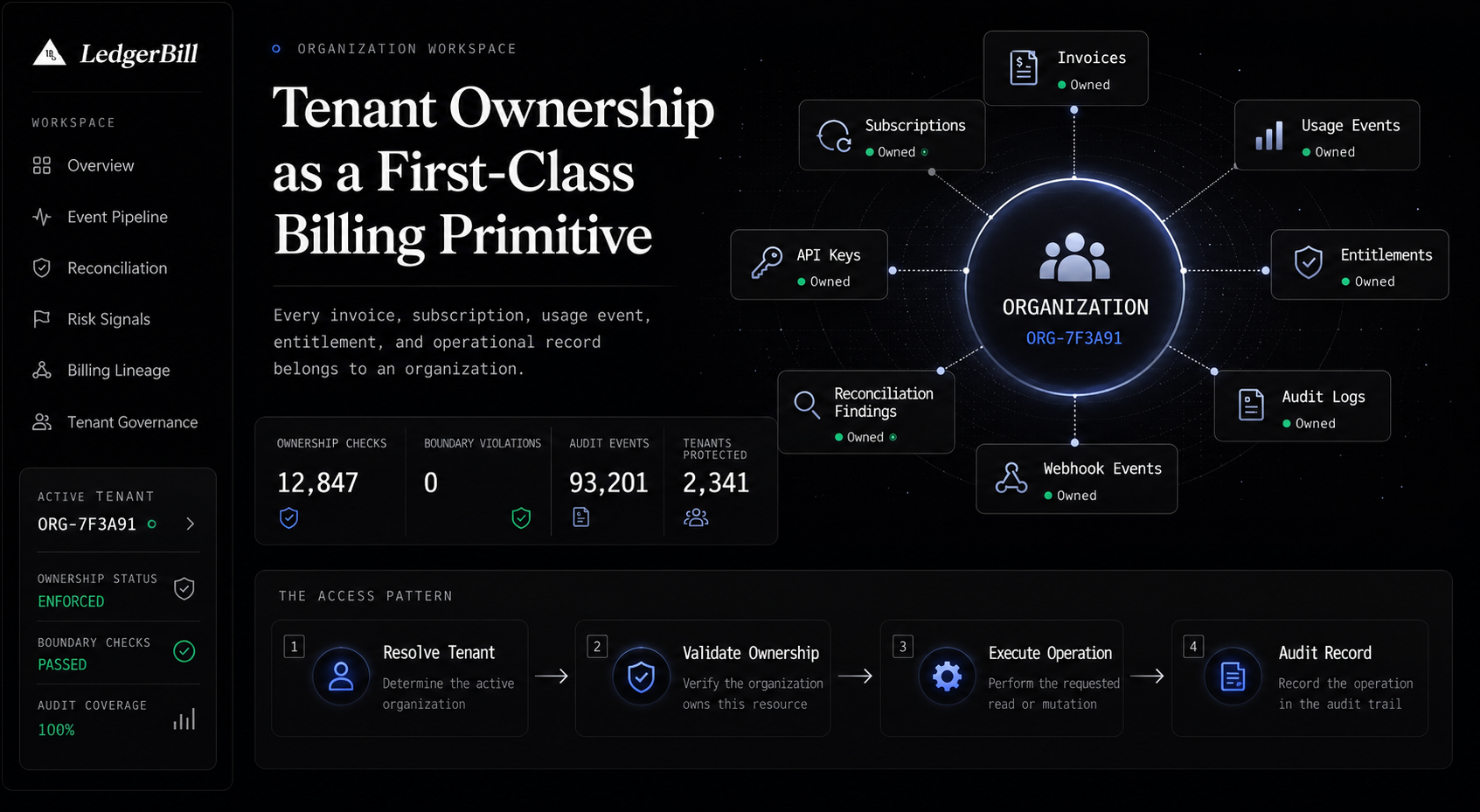
It is a product architecture problem, an API design problem, a security problem, and an operational reliability problem.
Every invoice, subscription, usage event, entitlement, reconciliation finding, audit record, and API request ultimately belongs to an organization. If ownership is not consistently enforced across the platform, billing systems become difficult to secure, reason about, and operate.
At LedgerBill, tenant ownership is treated as a first-class billing primitive rather than an implementation detail.
The Core Principle
Every billing operation should answer one question before any data is returned or modified:
Which organization owns this record?
This question applies everywhere:
- Invoices
- Subscriptions
- Usage records
- Meter events
- Entitlements
- API keys
- Webhook events
- Reconciliation findings
- Replay operations
- Audit logs
- Operational alerts
Ownership should be established before business logic executes, not after.
Ownership Before Data
One of the most common mistakes in multi-tenant systems is treating identifiers as sufficient authorization.
An identifier may appear globally unique, but uniqueness is not ownership.
For example:
- An invoice ID does not prove access to an invoice.
- A subscription ID does not prove ownership of a subscription.
- A finding ID does not grant permission to repair a finding.
- An event ID does not authorize replaying an event.
Production billing systems should never assume that possession of an identifier grants access to a resource.
Instead, ownership must be validated explicitly.
The Recommended Access Pattern
Every billing operation should follow a predictable flow:
- Resolve the active organization.
- Validate ownership of the target resource.
- Perform the requested read or mutation.
- Record the operation in an audit trail.
Conceptually:
User Request
      ↓
Resolve Tenant
      ↓
Validate Ownership
      ↓
Execute Operation
      ↓
Audit and Record
This pattern creates a consistent security boundary across the platform.
Whether a user is viewing an invoice, rotating an API key, repairing a reconciliation finding, or replaying a billing event, the ownership model remains identical.
Why This Matters
As billing platforms evolve, the number of operational surfaces grows rapidly.
A modern billing system may contain:
- Subscription management
- Usage metering
- Invoice generation
- Entitlement projection
- Revenue analytics
- Event pipelines
- Reconciliation workflows
- Audit tooling
- Administrative controls
Without a strong ownership model, every new feature becomes a potential cross-tenant access risk.
A tenant-aware architecture prevents these issues by ensuring every service operates within the same organizational boundary.
Tenant Isolation Should Feel Invisible
Strong tenant isolation should not create friction for customers.
In a well-designed system, users rarely think about ownership enforcement because it happens automatically.
The experience should feel simple:
- Select an organization.
- View that organization's subscriptions.
- Review that organization's invoices.
- Inspect that organization's usage.
- Manage that organization's API keys.
- Resolve that organization's operational findings.
Everything presented to the user belongs to the active organization, and nothing else.
This simplicity is the result of disciplined ownership enforcement behind the scenes.
Stripe, Organizations, and Ownership
In SaaS billing systems, Stripe often acts as the source of truth for customers and subscriptions.
LedgerBill extends that relationship by mapping Stripe entities to organizational ownership.
A typical ownership chain looks like:
Stripe Customer
      ↓
Stripe Subscription
      ↓
LedgerBill Organization
      ↓
Usage
Entitlements
Invoices
Audit Records
Operational State
Every downstream projection originates from a known organization.
This creates a complete lineage path from a Stripe event to a business decision.
Operational Benefits
Treating tenant ownership as a foundational concept provides several advantages:
Stronger Security
Every operation is constrained by organizational ownership.
Easier Auditing
Access decisions become traceable and explainable.
Safer Automation
Background jobs, replay systems, and reconciliation workflows operate within known tenant boundaries.
Predictable APIs
Developers can reason about ownership consistently across all endpoints.
Simplified Support
Support teams can quickly determine which organization owns a resource and why a decision was made.
The Production Standard
The goal of multi-tenant billing is not simply storing data for multiple customers.
The goal is ensuring every billing decision can be traced back to the organization that owns it.
Ownership should exist before projection.
Ownership should exist before access.
Ownership should exist before mutation.
When tenant ownership becomes a first-class primitive, billing systems become easier to secure, easier to audit, and easier to trust.
That is the baseline for production-grade SaaS billing.