Stripe as the Billing Source of Truth
Building a SaaS product involves more than collecting payments. A billing system must reliably answer fundamental business questions:
- Does this customer have an active subscription?
- Which plan are they on?
- What features should they have access to?
- Has payment been collected successfully?
- How much usage should be billed?
- Why was an invoice generated?
Many billing systems become difficult to manage because multiple services attempt to answer these questions independently. Over time, billing state becomes fragmented across databases, dashboards, entitlement services, support tools, and reporting systems.
LedgerBill is designed around a different principle:
Stripe remains the source of truth for billing. LedgerBill turns that billing data into operational intelligence.
The Modern SaaS Billing Flow
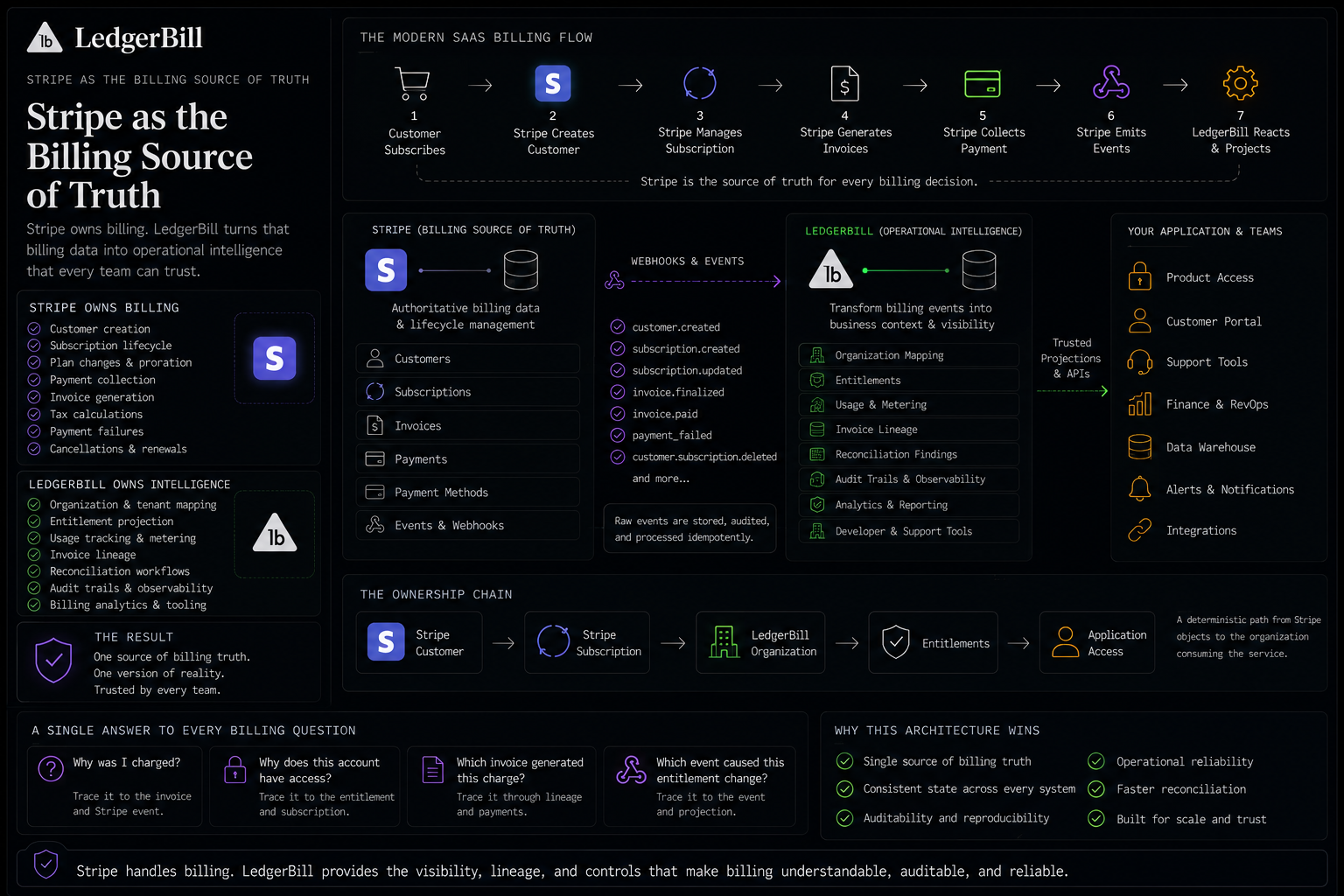
Stripe's recommended SaaS architecture centers around a clear lifecycle:
- A customer subscribes through Checkout.
- Stripe creates and manages the customer record.
- Stripe manages the subscription lifecycle.
- Stripe generates invoices and collects payment.
- Stripe emits events through webhooks.
- Downstream systems react to those events.
This model works because there is a single authoritative system responsible for billing decisions.
Instead of recreating billing logic internally, LedgerBill consumes Stripe events and projects them into operational state that can be understood by engineering, support, finance, and product teams.
What Stripe Owns
Stripe should be responsible for all billing decisions, including:
- Customer creation
- Subscription lifecycle management
- Plan changes
- Payment collection
- Invoice generation
- Tax calculations
- Payment failures
- Subscription cancellations
- Renewals and proration
If Stripe says a subscription is active, every downstream system should ultimately derive that state from Stripe rather than attempting to calculate it independently.
This dramatically reduces complexity and eliminates many common billing inconsistencies.
What LedgerBill Owns
LedgerBill operates above the billing layer.
Its responsibility is to transform billing events into business context and operational visibility.
LedgerBill provides:
- Organization and tenant mapping
- Entitlement projection
- Usage tracking and metering
- Invoice lineage
- Reconciliation workflows
- Audit trails
- Event observability
- Billing analytics
- Developer integration tooling
Stripe determines what happened.
LedgerBill explains why it happened and how it affects the customer.
The Ownership Chain
A reliable billing platform requires a deterministic path from a Stripe object to the organization consuming the service.
The ownership chain typically follows this structure:
Stripe Customer
      ↓
Stripe Subscription
      ↓
LedgerBill Organization
      ↓
Entitlements
      ↓
Application Access
This relationship must be established before any downstream projection occurs.
Without ownership, there is no trustworthy way to determine:
- Which organization owns the subscription
- Which users should receive access
- Which usage events belong to which tenant
- Which invoice belongs to which customer
The ownership relationship becomes the foundation of the entire billing system.
Why Projection Matters
A billing system rarely consists of a single database.
Subscription information typically appears in:
- Checkout pages
- Customer portals
- Internal dashboards
- Support systems
- Product entitlement services
- Reporting systems
- Finance platforms
If each system attempts to maintain its own interpretation of subscription status, inconsistencies emerge.
For example:
- Checkout reports an active subscription.
- The application dashboard reports an unpaid account.
- Entitlements continue granting access.
- Support sees a canceled subscription.
- Finance reports a failed payment.
All of these systems may be technically correct based on their local data, yet collectively they create operational confusion.
LedgerBill solves this by treating Stripe events as the canonical input and building deterministic projections from that source.
Event-Driven Billing
Stripe emits lifecycle events whenever billing activity occurs.
Examples include:
- Customer created
- Subscription created
- Subscription updated
- Invoice finalized
- Invoice paid
- Payment failed
- Subscription canceled
LedgerBill records these events and builds traceable projections from them.
This provides several advantages:
Auditability
Every billing decision can be traced back to an originating Stripe event.
Reproducibility
State can be rebuilt if projections need to be recalculated.
Transparency
Support and finance teams can understand exactly why a customer is in a particular billing state.
Reliability
Systems react to billing changes rather than attempting to predict them.
Usage-Based Billing
Many SaaS companies combine subscriptions with metered usage.
In this model:
- Stripe manages subscription pricing.
- LedgerBill tracks usage.
- LedgerBill validates and reconciles usage events.
- Stripe invoices based on approved usage records.
This separation allows each system to focus on its strengths.
Stripe excels at billing.
LedgerBill excels at measurement, lineage, and reconciliation.
Together they create a complete usage-based billing platform.
A Single Answer to Every Billing Question
The most valuable outcome of this architecture is consistency.
When a customer asks:
Why was I charged?
The answer should be traceable.
When support asks:
Why does this account have access?
The answer should be traceable.
When finance asks:
Which invoice generated this charge?
The answer should be traceable.
When engineering asks:
Which event caused this entitlement change?
The answer should be traceable.
LedgerBill's purpose is not to replace Stripe.
Its purpose is to provide the visibility, lineage, and operational controls that sit between Stripe's billing engine and the rest of the business.
The Result
A well-designed billing platform separates responsibility clearly:
Stripe owns billing truth.
LedgerBill owns operational understanding.
That distinction allows organizations to build systems that are easier to audit, easier to support, easier to scale, and significantly easier to trust.
When finance, support, engineering, and customers all receive the same answer from the same evidence, billing stops being a source of uncertainty and becomes a reliable part of the product.