Stripe Connect in Practice: Safe Identifier Validation and Catalog Overrides
One of the most common billing mistakes is surprisingly simple:
Hardcoding Stripe identifiers directly into application code.
At first, it seems harmless.
A developer copies a Stripe Price ID into a constant:
const PRO_PLAN_PRICE = "price_123456789";
The application launches successfully.
Checkout works.
Subscriptions work.
Everything appears fine.
Until the first migration, environment change, pricing update, or enterprise contract arrives.
What began as a shortcut becomes a source of operational risk.
Modern billing systems need a safer approach.
They need validated identifiers, environment-aware configuration, and catalog-driven behavior.
The Hidden Cost of Hardcoded IDs
Stripe resources are represented by identifiers such as:
prod_...
price_...
cus_...
sub_...
acct_...
These identifiers are intended to be references, not business logic.
Yet many applications embed them directly into code.
Examples include:
- Checkout flows
- Upgrade paths
- Pricing pages
- Entitlement systems
- Usage limits
- Feature gating
This creates tight coupling between application behavior and Stripe configuration.
A seemingly harmless pricing change can suddenly require a production deployment.
The Environment Problem
Most organizations operate multiple environments.
For example:
Development
Staging
Production
Each environment typically contains different Stripe resources.
A production Price ID may not exist in staging.
A staging Product ID may not exist in development.
Hardcoded identifiers quickly become difficult to maintain.
Teams often find themselves writing logic such as:
if (process.env.NODE_ENV === "production") {
  return "price_prod";
}

return "price_dev";
The result is fragile and difficult to audit.
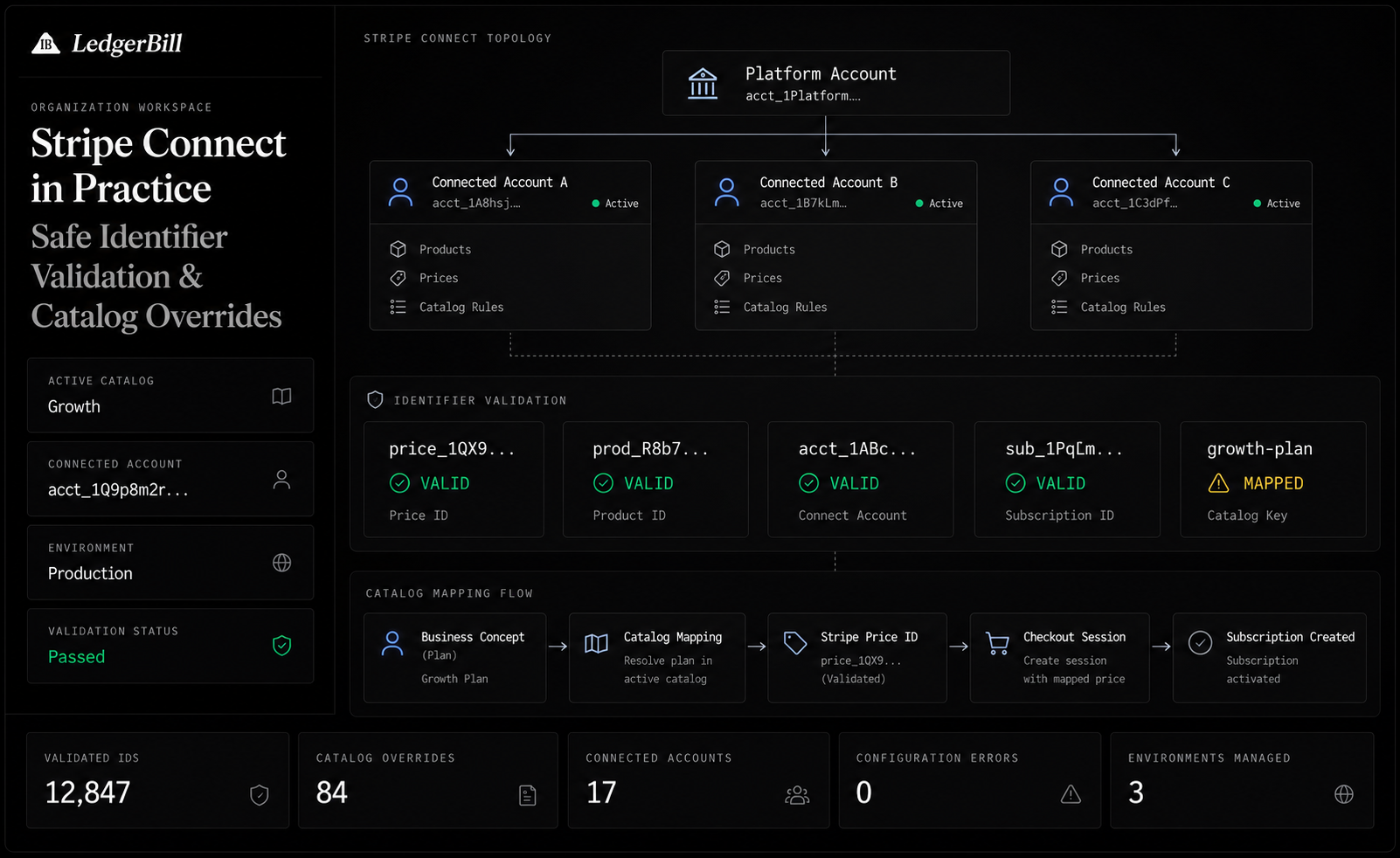
A Better Approach: Catalog Mapping
Instead of treating Stripe IDs as application constants, treat them as configuration.
The application should operate on business concepts:
Starter
Growth
Enterprise
Configuration should map those concepts to Stripe resources.
For example:
plans:
  starter:
    stripePriceId: price_xxx
  growth:
    stripePriceId: price_yyy
  enterprise:
    stripePriceId: price_zzz
Application logic references plans.
Configuration references Stripe.
This separation dramatically reduces operational complexity.
Introducing Safe Identifier Validation
Configuration alone is not enough.
Applications should also verify that supplied identifiers appear valid before they are used.
This is where helpers such as:
isConfiguredStripeIdentifier()
become valuable.
Rather than blindly trusting configuration, applications validate expected formats.
For example:
price_...
prod_...
acct_...
Invalid values can be detected early during startup rather than during customer checkout.
The goal is not to guarantee the resource exists.
The goal is to prevent obviously incorrect configuration from entering the billing system.
Why Validation Matters
Consider these common deployment issues:
Missing Environment Variables
STRIPE_PRICE_GROWTH=
Copy/Paste Errors
STRIPE_PRICE_GROWTH=prod_123
when a Price ID is expected.
Cross-Environment References
STRIPE_PRICE_GROWTH=price_live_xxx
accidentally used in staging.
Without validation, these issues often surface only when a customer attempts to subscribe.
With validation, they can be detected during deployment.
Separating Catalogs From Stripe
One of the most useful architectural patterns is distinguishing between:
Product Catalog
Business definitions:
Growth Plan
$99/month
100,000 API calls
Priority Support
Stripe Configuration
Billing definitions:
Product ID
Price ID
Checkout Mapping
Billing Metadata
The application owns the catalog.
Stripe owns billing execution.
Configuration connects the two.
This creates a clear system-of-record boundary.
Supporting Catalog Overrides
As companies grow, pricing becomes more complicated.
Organizations may receive:
- Enterprise contracts
- Legacy pricing
- Promotional plans
- Private offerings
- Migration discounts
Eventually, not every customer belongs to the public catalog.
A configuration-driven approach makes these scenarios manageable.
For example:
enterprise-customer:
  priceId: price_enterprise_custom
The application still operates on plan concepts.
Only the configuration changes.
No code deployment is required.
Stripe Connect and Multi-Tenant Platforms
The challenge becomes even more important when Stripe Connect enters the picture.
Platforms may manage:
Platform Account
Connected Account A
Connected Account B
Connected Account C
Each account may contain different:
- Products
- Prices
- Catalogs
- Billing rules
Hardcoded identifiers become increasingly dangerous.
Validated configuration and catalog mapping become essential.
The platform should understand:
Which catalog applies to this tenant?
before attempting to create subscriptions or checkout sessions.
Operational Benefits
Moving from hardcoded IDs to validated configuration provides several advantages.
Safer Deployments
Configuration errors are detected earlier.
Cleaner Code
Business logic references plans rather than Stripe internals.
Easier Environment Management
Development, staging, and production remain isolated.
Faster Pricing Changes
Catalog updates become configuration changes rather than code releases.
Better Auditability
Billing behavior becomes easier to explain and review.
A Practical Decision Framework
When introducing Stripe into a SaaS platform:
Avoid:
const PRICE_ID = "price_123";
Prefer:
const plan = catalog.get("growth");
const priceId = plan.stripePriceId;
Validate:
isConfiguredStripeIdentifier(priceId)
before using it.
The goal is to treat Stripe identifiers as infrastructure configuration rather than application logic.
Final Thoughts
Stripe IDs are implementation details.
Plans, subscriptions, entitlements, and pricing tiers are business concepts.
Successful billing architectures keep those concerns separate.
Validated identifiers prevent configuration mistakes.
Catalog mappings create flexibility.
Environment-driven overrides support growth.
Together, these patterns allow organizations to evolve pricing models, support enterprise customers, and manage multiple environments without turning billing logic into a collection of hardcoded values.
The result is a billing platform that is easier to operate, easier to scale, and significantly safer to change.