Route Registry and OpenAPI Drift Prevention in CI
One of the most common sources of API failures is not infrastructure.
It is documentation drift.
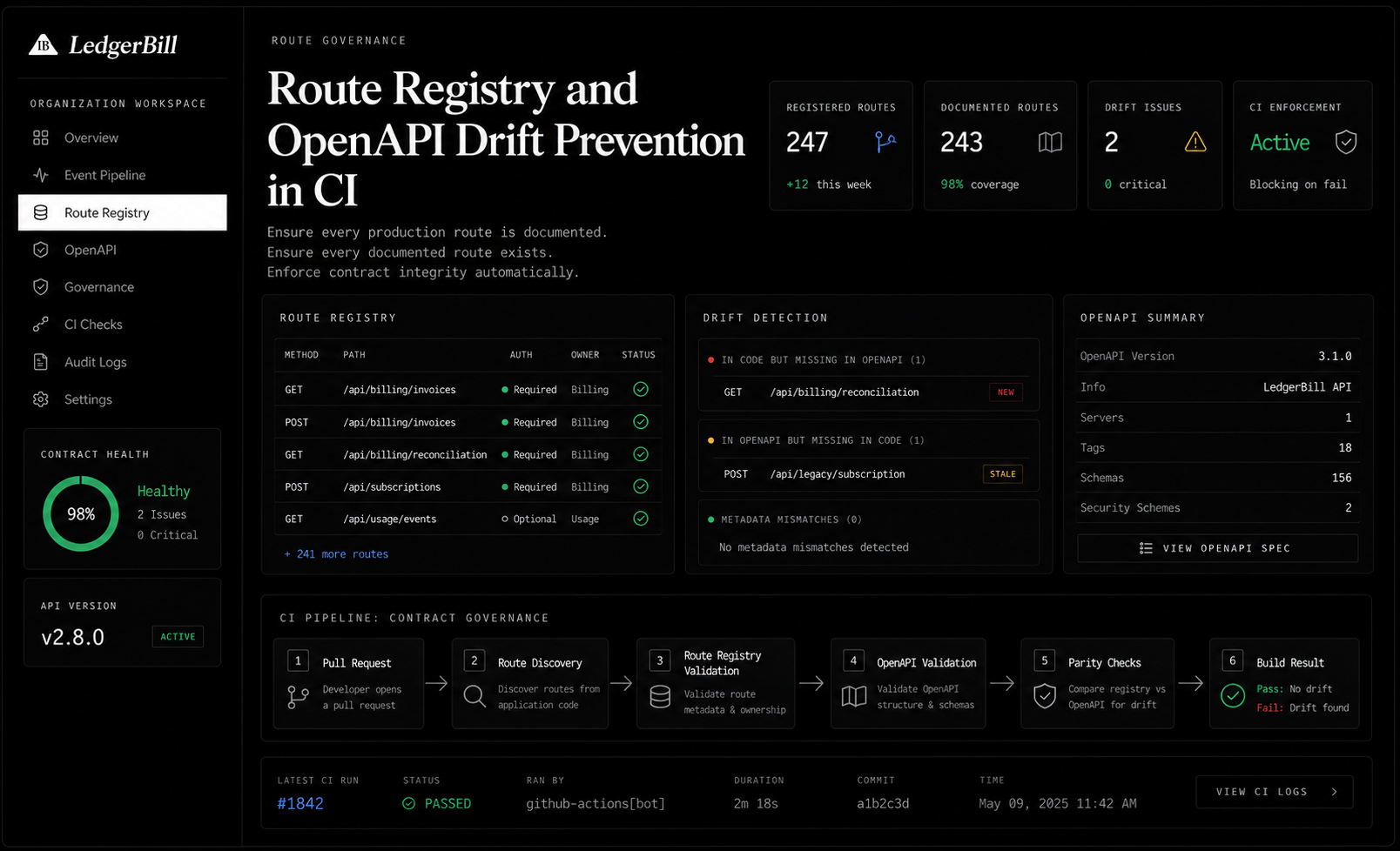
A route exists in production but never appears in the OpenAPI specification.
A documented endpoint was removed months ago but still appears in the docs.
Authentication requirements change without corresponding documentation updates.
Response schemas evolve while client SDKs continue generating outdated code.
Over time, the API contract and the actual implementation become two different systems.
This problem is rarely intentional.
It emerges naturally as products grow.
The solution is not better documentation habits.
The solution is governance.
The Cost of API Drift
Most teams discover API drift indirectly.
A customer reports an endpoint does not behave as documented.
An SDK generates invalid requests.
A frontend consumes fields that no longer exist.
A support engineer references documentation that no longer matches production behavior.
The underlying issue is the same:
The API implementation and the API contract have diverged.
Once that happens, every consumer begins operating from a different version of reality.
APIs Are Contracts
An API is more than a collection of routes.
It is a contract between systems.
That contract defines:
- Available endpoints
- Authentication requirements
- Request schemas
- Response schemas
- Error formats
- Versioning behavior
OpenAPI provides a standardized representation of that contract.
The challenge is ensuring the contract remains aligned with implementation.
Why Documentation Alone Fails
Many organizations rely on manual processes:
- Build endpoint.
- Update documentation.
- Hope documentation remains current.
This works for small teams.
It fails at scale.
The larger the platform becomes, the more likely implementation changes occur without corresponding documentation updates.
Documentation becomes a lagging indicator.
The API becomes the source of truth.
Eventually the two disagree.
The Role of a Route Registry
A route registry creates a centralized inventory of application endpoints.
Instead of routes being scattered across controllers, handlers, and modules, they are registered through a common system.
For example:
Route Definition
        ↓
Route Registry
        ↓
Governance Validation
        ↓
OpenAPI Generation
The registry becomes the authoritative source for route discovery.
This creates visibility into:
- Existing endpoints
- Ownership
- Authentication requirements
- Tags and categories
- Documentation status
Most importantly, it provides a foundation for automated validation.
Route Registries as Governance Infrastructure
The value of a route registry is not route discovery.
The value is enforcement.
Once every route is registered, governance tooling can answer questions such as:
- Is this route documented?
- Is documentation missing?
- Is the route deprecated?
- Does OpenAPI contain stale endpoints?
- Are authentication requirements declared?
- Are response schemas defined?
The registry becomes a mechanism for enforcing platform standards.
Preventing OpenAPI Drift
The next step is comparing implementation against documentation.
This is where route parity checks become valuable.
Conceptually:
Runtime Routes
        ↓
Route Registry
        ↓
Parity Validation
        ↓
OpenAPI Specification
The validation process compares:
Routes Present in Code but Missing in OpenAPI
Example:
GET /api/billing/reconciliation
exists in production but not in documentation.
Routes Present in OpenAPI but Missing in Code
Example:
POST /api/legacy/subscription
remains documented despite being removed.
Metadata Mismatches
Examples include:
- Incorrect tags
- Missing authentication requirements
- Missing operation identifiers
- Missing schema definitions
These issues can be detected automatically.
Governance Checks in CI
Manual audits do not scale.
Validation should occur during every build.
A typical governance pipeline looks like:
Pull Request
       ↓
Route Discovery
       ↓
Route Registry Validation
       ↓
OpenAPI Validation
       ↓
Parity Checks
       ↓
Build Passes
If a discrepancy is detected, CI fails.
Developers receive immediate feedback rather than discovering problems after deployment.
This transforms governance from a process into an automated control.
Contract Hygiene as an Engineering Discipline
Most organizations treat documentation as a communication problem.
Mature platforms treat it as a contract-management problem.
The objective is not merely generating documentation.
The objective is maintaining contract integrity.
Every route should have:
- Ownership
- Documentation
- Schemas
- Authentication metadata
- Validation coverage
Anything less creates uncertainty for consumers.
Benefits Beyond Documentation
Preventing API drift creates benefits throughout the platform.
Better Developer Experience
Developers can trust documentation.
Better SDK Generation
Generated clients remain aligned with production behavior.
Faster Onboarding
New engineers understand the platform more quickly.
Reduced Support Burden
Customers encounter fewer discrepancies.
Safer Refactoring
Route changes become visible immediately.
Stronger Governance
Platform standards become enforceable rather than aspirational.
Route Parity as a Production Requirement
As organizations scale, APIs become products.
API consumers include:
- Frontend applications
- Internal services
- Partners
- Customers
- SDKs
- Automation systems
Each consumer relies on the contract being accurate.
A route parity script provides a simple but powerful guarantee:
Every documented route exists, and every production route is documented.
That guarantee becomes increasingly valuable as platforms grow.
The LedgerBill Approach
LedgerBill treats API governance as operational infrastructure.
The combination of:
- Route Registry
- OpenAPI specifications
- Governance validation
- Route parity checks
- CI enforcement
creates a continuous verification system for API contracts.
Rather than relying on manual reviews, the platform continuously validates that implementation and documentation remain synchronized.
This turns API governance into an engineering capability rather than a documentation exercise.
Final Thoughts
API drift is not a documentation problem.
It is a contract-management problem.
The larger the platform becomes, the more expensive contract drift becomes.
Route registries provide visibility.
OpenAPI provides standardization.
Governance checks provide enforcement.
CI provides continuous validation.
Together, they create a system where API contracts remain trustworthy, documentation remains accurate, and consumers can build against the platform with confidence.
Because the best API documentation is not the most detailed documentation.
It is the documentation that is guaranteed to be correct.