Reconciliation as a Product Feature (Not a Backoffice Job)
Many billing systems treat reconciliation as a hidden operational task.
A background worker runs overnight.
Logs are generated.
Records are compared.
Discrepancies are silently repaired.
Most customers never know it happened.
Most support teams never see it happen.
Most engineers only discover it when something goes wrong.
This model worked when billing systems were simple.
Modern SaaS platforms are no longer simple.
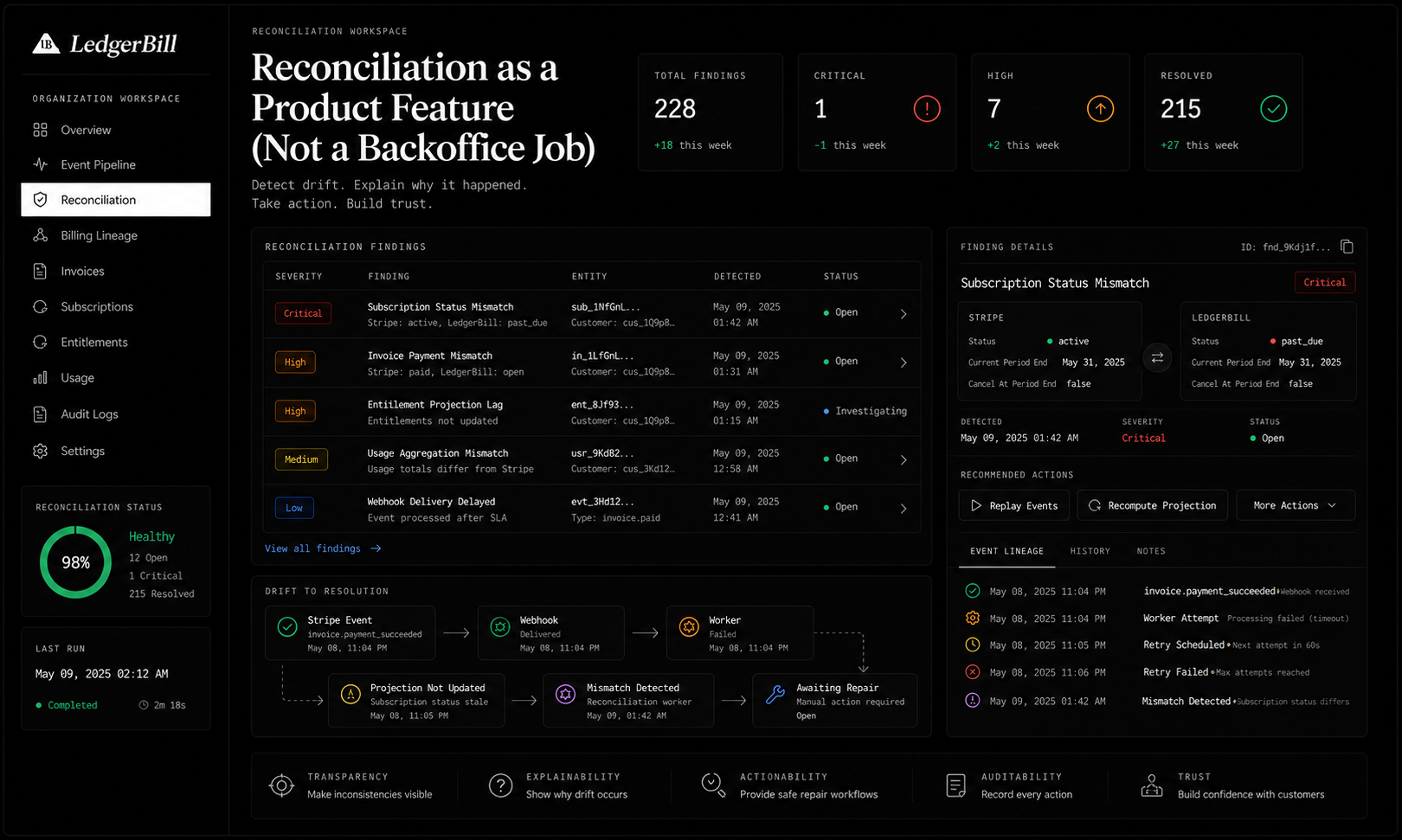
They are distributed systems composed of subscriptions, invoices, usage events, entitlement projections, webhooks, retries, workers, and multiple sources of truth.
In this environment, reconciliation should not be treated as a backoffice activity.
It should be treated as a product feature.
Why Drift Is Inevitable
Modern billing flows are asynchronous by design.
A customer completes checkout.
Stripe creates a subscription.
A webhook is delivered.
A worker processes the event.
Entitlements are recalculated.
Usage limits are updated.
Internal projections are refreshed.
Each step occurs independently.
At any point, a delay, failure, timeout, retry, or deployment can introduce temporary inconsistency.
For example:
Stripe Subscription
        ↓
Webhook Delivery Delayed
        ↓
Entitlements Not Updated
        ↓
Customer Reports Missing Access
Nothing is technically broken.
The system simply has not converged yet.
This is known as drift.
The important realization is that drift is not an exception.
Drift is a normal property of distributed systems.
The Wrong Question
Many teams ask:
How do we prevent drift?
The better question is:
How do we detect, explain, and safely recover from drift?
No amount of engineering completely eliminates asynchronous behavior.
What separates mature billing systems from immature ones is operational visibility.
Reconciliation Creates Trust
Customers trust billing systems when they can understand them.
Support teams trust billing systems when they can explain them.
Engineering teams trust billing systems when they can verify them.
Reconciliation provides that trust layer.
Instead of hiding inconsistencies, the platform exposes them.
Instead of forcing operators to inspect logs, the platform surfaces findings.
Instead of creating support mysteries, the platform provides evidence.
The result is a billing system that can explain itself.
What a Reconciliation Finding Should Contain
A reconciliation record should be actionable.
It should answer:
What Is Wrong?
For example:
Subscription Status Mismatch
What Does Stripe Say?
Active
What Does LedgerBill Say?
Past Due
How Severe Is It?
Warning
High
Critical
What Can Be Done?
Replay Event
Recompute Projection
Requeue Worker
Ignore
Resolve
This transforms reconciliation from a technical process into an operational workflow.
Background Workers Are Not Enough
Workers remain essential.
They detect inconsistencies.
They compare states.
They generate findings.
But workers should not be the end of the story.
A reconciliation worker is a detection mechanism.
The product experience is what happens next.
The customer-facing and operator-facing platform should expose:
- Findings
- Severity
- History
- Repair actions
- Resolution status
Without that visibility, reconciliation becomes invisible until it fails.
The Support Team Problem
Most billing escalations begin with a question.
Examples include:
- Why was access removed?
- Why does Stripe show active but the dashboard does not?
- Why is usage different than expected?
- Why was this invoice generated?
Without reconciliation tooling, support teams often become intermediaries between customers and engineering.
The process looks like:
Customer
    ↓
Support
    ↓
Engineering
    ↓
Database Query
    ↓
Log Investigation
    ↓
Answer
This does not scale.
A reconciliation-driven platform allows support teams to see findings directly.
Many investigations become self-service.
Many escalations disappear entirely.
Explainability Requires Lineage
Reconciliation answers:
What does not match?
Lineage answers:
Why does it not match?
Both are necessary.
For example:
Stripe Invoice Paid
        ↓
Webhook Received
        ↓
Worker Failed
        ↓
Projection Not Updated
        ↓
Mismatch Detected
The reconciliation finding identifies the discrepancy.
The lineage system explains the chain of events that produced it.
Together, they create operational explainability.
Why Customers Benefit
Most customers do not care about reconciliation.
They care about outcomes.
They want confidence that:
- Their subscription is correct.
- Their invoices are correct.
- Their usage is correct.
- Their access is correct.
A visible reconciliation layer provides that confidence.
When an issue occurs, there is evidence.
When a discrepancy exists, there is a workflow.
When a correction happens, there is an audit trail.
Trust increases because the system can explain itself.
Reconciliation as a Control Plane
The most mature billing platforms treat reconciliation as part of the operational control plane.
It becomes a first-class capability alongside:
- Invoices
- Subscriptions
- Usage
- Entitlements
- Audit history
- Lineage
Operators gain the ability to:
- Inspect drift
- Investigate causes
- Trigger repairs
- Replay events
- Monitor resolution progress
The platform moves from reactive troubleshooting to proactive operations.
The LedgerBill Approach
LedgerBill treats reconciliation as an observable workflow rather than a hidden maintenance task.
Background workers still perform detection.
But the findings become part of the product experience.
Every discrepancy should be:
- Visible
- Explainable
- Auditable
- Actionable
The goal is not merely to keep systems synchronized.
The goal is to help operators understand why systems become unsynchronized and how to recover safely.
Final Thoughts
Billing systems are judged most harshly when something goes wrong.
When customers lose access.
When invoices appear incorrect.
When usage does not match expectations.
When subscription state becomes unclear.
In those moments, hidden background jobs are not enough.
Organizations need visibility.
Support teams need evidence.
Operators need workflows.
Customers need confidence.
That is why reconciliation should not be treated as a backoffice process.
It should be treated as a product feature.
Because the most trustworthy billing systems are not the ones that never experience drift.
They are the ones that can detect it, explain it, and recover from it transparently.