Pricing Catalog as a Control Plane: One Source for Marketing, Checkout, and Enforcement
Most pricing problems are not actually pricing problems.
They are consistency problems.
Marketing says one thing.
Checkout sells another.
The product enforces something different.
Support explains a fourth version.
Finance reports a fifth.
The result is confusion, customer frustration, and a gradual erosion of trust.
The root cause is usually the same:
The organization has multiple sources of truth for pricing.
Modern SaaS platforms need a different approach.
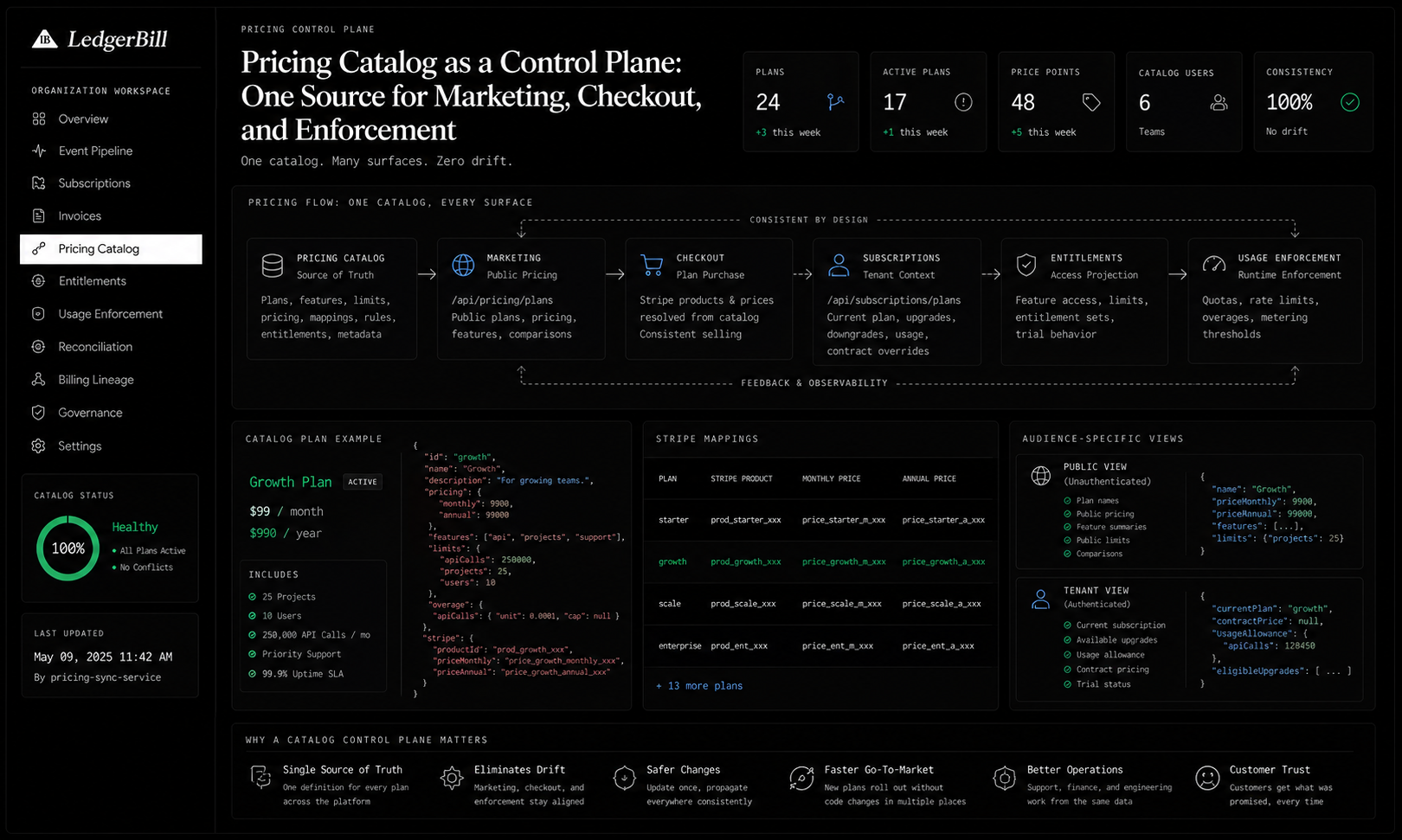
They need a pricing catalog that acts as a control plane.
Not merely a list of plans.
A system responsible for governing how pricing is represented, sold, and enforced across the entire platform.
The Hidden Cost of Pricing Drift
Most companies begin with simple pricing.
A landing page contains a few cards.
Developers manually create matching Stripe products.
Feature limits are added directly into application code.
For example:
if (plan === "starter") {
  maxProjects = 5;
}
Everything appears manageable.
Until it isn't.
Over time, changes occur independently:
- Marketing updates pricing.
- Product introduces new limits.
- Stripe prices are modified.
- Entitlements evolve.
- Enterprise plans appear.
- Legacy plans remain active.
Eventually, every system contains a slightly different version of reality.
One Plan, Four Interpretations
Consider a hypothetical Growth plan.
Marketing believes it includes:
100,000 API calls
10 users
Priority support
Stripe sells:
250,000 API calls
10 users
Priority support
The application enforces:
150,000 API calls
10 users
Support documentation references:
Unlimited API calls
Which version is correct?
Customers should never have to ask.
The Pricing Catalog Problem
Most organizations treat pricing as content.
In reality, pricing is infrastructure.
A pricing catalog defines:
- Plans
- Features
- Limits
- Overage rules
- Trial behavior
- Entitlements
- Upgrade paths
- Billing mappings
Every other billing surface should derive from that catalog.
The catalog becomes a control plane for commercial behavior.
What a Control Plane Actually Means
A control plane does not execute billing.
It governs billing behavior.
Conceptually:
Pricing Catalog
       ↓
Marketing
       ↓
Checkout
       ↓
Subscriptions
       ↓
Entitlements
       ↓
Usage Enforcement
Every system references the same source of truth.
Instead of maintaining independent plan definitions, systems consume catalog definitions.
The result is consistency across the platform.
Marketing and Pricing Alignment
Public pricing pages are often the first place drift appears.
For example:
GET /api/pricing/plans
can expose:
- Plan names
- Public pricing
- Feature summaries
- Public limits
- Upgrade comparisons
Rather than hardcoding pricing cards into the frontend, the website consumes the catalog directly.
Marketing becomes aligned with the actual commercial model.
Checkout Alignment
The next consumer is checkout.
Whether using Stripe Checkout, custom flows, or enterprise quoting systems, checkout should derive from the same catalog.
The catalog should define:
Growth Plan
       ↓
Stripe Product
       ↓
Stripe Price
Instead of embedding Stripe identifiers throughout the application, checkout resolves plans through catalog mappings.
This ensures customers purchase exactly what marketing promised.
Subscription Alignment
Once checkout completes, the subscription system becomes responsible for operational state.
For example:
GET /api/subscriptions/plans
may return:
- Current subscription
- Available upgrades
- Available downgrades
- Usage allowances
- Contract-specific overrides
The key distinction is that tenant-aware subscription APIs should still derive their plan definitions from the same pricing catalog.
The catalog remains the foundation.
The subscription layer adds tenant context.
Entitlements and Enforcement
The pricing catalog should also govern product behavior.
For example:
growth:
  projects: 25
  users: 10
  apiCalls: 250000
  support: priority
Entitlement systems consume these definitions directly.
Usage enforcement consumes the same definitions.
Feature flags consume the same definitions.
The application no longer invents plan behavior independently.
Instead, it projects catalog definitions into operational state.
Why Stripe Should Not Be the Catalog
Stripe is excellent at billing execution.
Stripe is not a product catalog.
Stripe understands:
- Products
- Prices
- Customers
- Subscriptions
- Invoices
Stripe does not understand:
- Feature access
- User limits
- API quotas
- Internal entitlements
- Product capabilities
Those concepts belong inside the application.
The catalog becomes the bridge between product behavior and Stripe billing.
Supporting Enterprise and Legacy Plans
As organizations grow, pricing becomes more complicated.
Examples include:
- Enterprise contracts
- Legacy plans
- Promotional pricing
- Custom limits
- Migration programs
These plans often cannot appear on public pricing pages.
However, they still need to be represented consistently across billing and enforcement systems.
A centralized catalog provides a structured place for those exceptions.
The platform remains consistent even when commercial models become more complex.
Pricing Catalog as Operational Infrastructure
The catalog eventually becomes more than a pricing artifact.
It becomes operational infrastructure.
It influences:
Go-To-Market
Marketing pages and sales collateral.
Revenue Operations
Subscription management and upgrades.
Engineering
Feature enforcement and entitlement projection.
Support
Plan explanations and customer assistance.
Finance
Billing consistency and reconciliation.
Every department references the same definitions.
The LedgerBill Approach
LedgerBill treats pricing as a platform concern rather than a UI concern.
Public pricing endpoints expose catalog definitions for marketing experiences.
Subscription endpoints expose catalog definitions combined with tenant-specific billing state.
Checkout derives from catalog mappings.
Entitlements derive from catalog definitions.
Usage enforcement derives from catalog limits.
This creates a consistent flow:
Pricing Catalog
       ↓
Marketing
       ↓
Checkout
       ↓
Stripe Subscription
       ↓
Entitlements
       ↓
Usage Enforcement
Every system operates from the same commercial foundation.
Final Thoughts
Most pricing failures occur because organizations allow multiple versions of the truth to emerge.
Marketing creates one definition.
Checkout creates another.
Engineering creates a third.
Support documents a fourth.
A centralized pricing catalog eliminates those discrepancies.
It provides a single source of truth for what a plan is, what it costs, what it includes, and how it behaves.
The catalog becomes a control plane governing every pricing-related experience across the platform.
Because customers should never have to wonder whether the plan they purchased is the same plan the product actually enforces.
A well-designed pricing catalog ensures the answer is always yes.