Idempotency in Billing: Event IDs, Raw Payloads, and Audit Trails
Every billing platform eventually encounters the same question:
What happens when the same event arrives twice?
The answer matters more than most teams realize.
Stripe retries webhook deliveries.
Networks fail.
Workers restart.
Deployments interrupt processing.
Queues redeliver messages.
Operators replay events during incident recovery.
In distributed systems, duplicate delivery is not unusual.
It is expected.
The challenge is ensuring that duplicate delivery does not create duplicate business outcomes.
That is the purpose of idempotency.
The Myth of Exactly-Once Processing
Many engineers begin with a goal that sounds reasonable:
Process every event exactly once.
In practice, achieving true exactly-once processing across distributed systems is extremely difficult.
Most modern platforms instead embrace a different model:
Deliver events at least once and make processing idempotent.
This approach is simpler, more reliable, and aligns with how systems such as Stripe webhooks operate.
The implication is important:
Duplicate events are normal.
Duplicate business effects are not.
Why Billing Systems Are Especially Sensitive
Most applications can tolerate occasional duplicate processing.
Billing systems cannot.
Consider the consequences:
- A customer is charged twice.
- Entitlements are granted twice.
- Usage is counted twice.
- Revenue is overstated.
- Reconciliation findings multiply.
- Audit records become inconsistent.
The financial impact of duplicate processing can be significant.
Billing platforms require stronger guarantees than most application workflows.
The First Layer: Event IDs
The foundation of idempotent billing begins with event identity.
Stripe webhooks include unique event identifiers.
For example:
evt_123456789
These identifiers provide a stable reference for every event Stripe emits.
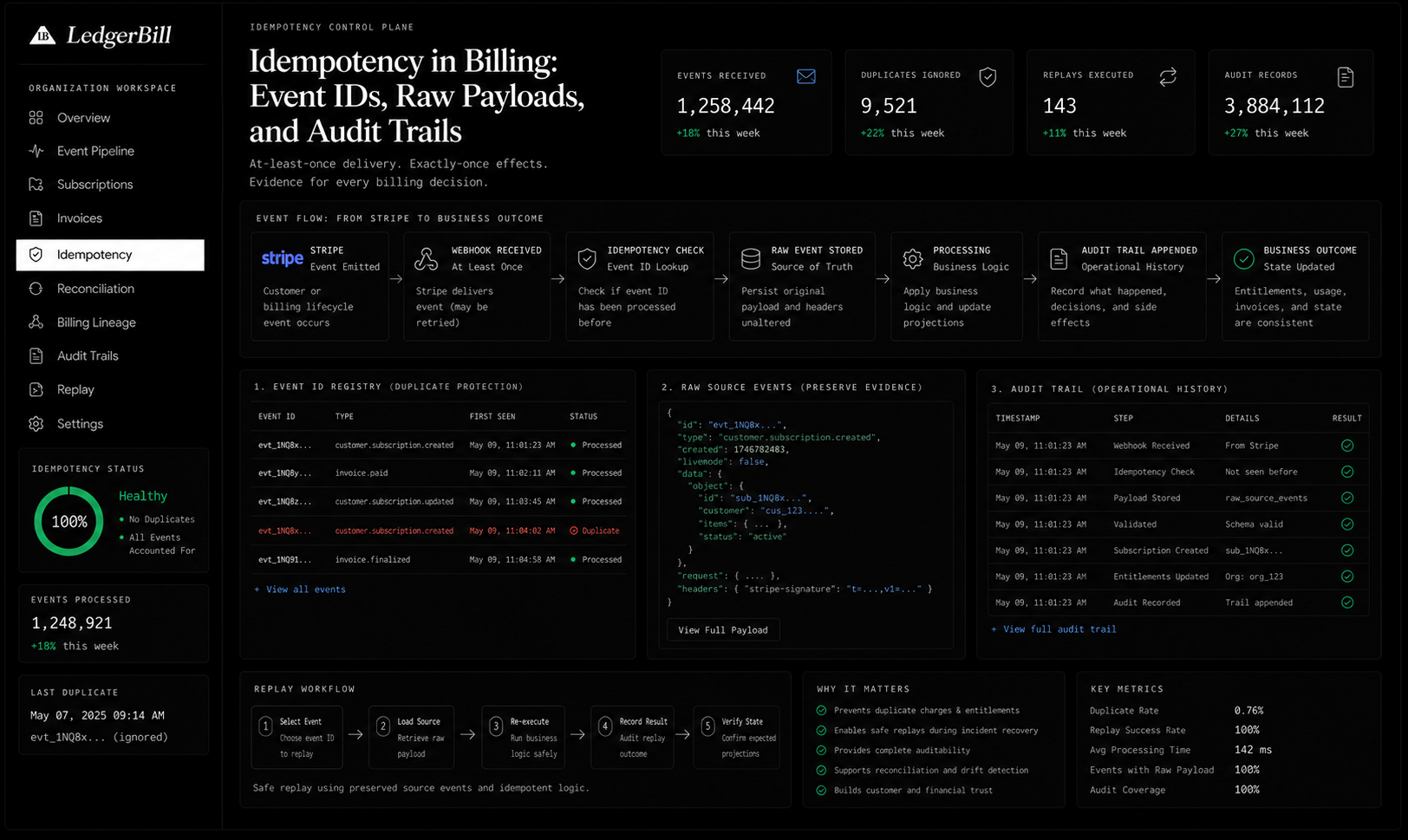
A common pattern is maintaining a dedicated event registry.
Conceptually:
stripe_event_ids
Before processing begins, the platform checks:
Has this event been seen before?
If the answer is yes, processing stops.
If the answer is no, processing continues.
This prevents duplicate deliveries from creating duplicate side effects.
Why Event IDs Alone Are Not Enough
Many teams stop here.
That is a mistake.
Event IDs protect against duplicate delivery.
They do not protect against operational uncertainty.
For example:
- Why was this event processed?
- What data was received?
- Was the payload modified later?
- Can the event be replayed?
- Can the decision be audited?
Answering these questions requires additional evidence.
The Second Layer: Raw Payload Storage
A billing platform should preserve the original event payload exactly as it was received.
Conceptually:
raw_source_events
This record should contain:
- Original JSON payload
- Headers
- Source system
- Timestamp
- Event identifier
- Processing metadata
The key principle is simple:
Preserve the event before transforming it.
This creates a permanent record of the source event.
Why Raw Events Matter
Imagine a support investigation six months later.
A customer asks:
Why was my subscription downgraded?
Without raw event retention, the platform may only possess the current state.
With raw event retention, the platform can inspect the exact webhook Stripe delivered.
The original evidence still exists.
This dramatically improves auditability and operational confidence.
The Third Layer: Audit Trails
Even raw events do not tell the complete story.
The platform also needs to record what happened after the event arrived.
For example:
Webhook Received
      ↓
Validated
      ↓
Projection Updated
      ↓
Entitlements Recalculated
      ↓
Invoice Updated
This operational history becomes the audit trail.
The audit trail answers:
What did the platform do with the event?
The raw payload answers:
What was received?
Both are required.
Understanding Safe Replay
Replay is one of the most misunderstood concepts in billing systems.
Many teams assume replay simply means:
Process Event Again
In reality, safe replay requires much more.
Before replaying an event, the platform should know:
- Which event is being replayed
- Whether the payload is unchanged
- Whether the event was processed previously
- Which projections were affected
- Which side effects occurred
Without this information, replay becomes dangerous.
What Replay Actually Requires
A production-grade replay workflow depends on three components:
Event Identity
stripe_event_ids
Provides duplicate detection.
Source Evidence
raw_source_events
Provides original payload preservation.
Operational History
webhook_audit_trail
Provides processing lineage.
Together they create the foundation for deterministic replay.
Replay vs Reprocessing
Another important distinction:
Replay
Re-execute business logic against preserved source events.
Reprocessing
Attempt to regenerate behavior from current state.
These are not equivalent.
Replay uses historical evidence.
Reprocessing often uses assumptions.
Billing systems should prefer replay whenever possible.
Supporting Reconciliation
Idempotency also plays a critical role in reconciliation.
Consider a mismatch between Stripe and internal projections.
The reconciliation workflow may determine:
Event Missing
or:
Projection Failed
A replay system allows operators to recover without manually modifying data.
The platform can safely reconstruct state from original events.
This reduces operational risk and improves consistency.
Building Trust Through Evidence
Customers rarely care about idempotency.
What they care about is confidence.
They want confidence that:
- Charges are correct.
- Access is correct.
- Usage is correct.
- Recoveries are safe.
Strong idempotency practices create that confidence.
Every billing decision becomes supported by evidence.
Every replay becomes traceable.
Every discrepancy becomes explainable.
The LedgerBill Approach
LedgerBill treats idempotency as more than duplicate detection.
Event identifiers prevent repeated processing.
Raw source events preserve original evidence.
Webhook audit trails capture operational decisions.
Together these components create a reliable foundation for:
- Safe replay
- Reconciliation
- Auditability
- Incident recovery
- Operational transparency
The goal is not merely preventing duplicates.
The goal is creating a billing system that can always explain what happened and safely recover when something goes wrong.
Final Thoughts
Idempotency is often reduced to a database constraint or a duplicate-event check.
In reality, safe billing systems require a broader approach.
Event IDs answer:
Have we seen this before?
Raw payloads answer:
What exactly arrived?
Audit trails answer:
What did we do with it?
Only when all three exist can a platform support reliable replay, trustworthy reconciliation, and defensible billing operations.
Because the real measure of idempotency is not whether duplicate events arrive.
It is whether the system can process, replay, and explain them without changing the outcome.