How to Design Multi-Tenant Billing APIs Without Leaking Context
Multi-tenant billing systems are fundamentally different from single-tenant applications.
The challenge is not generating invoices.
The challenge is ensuring that every billing operation executes within the correct organizational boundary.
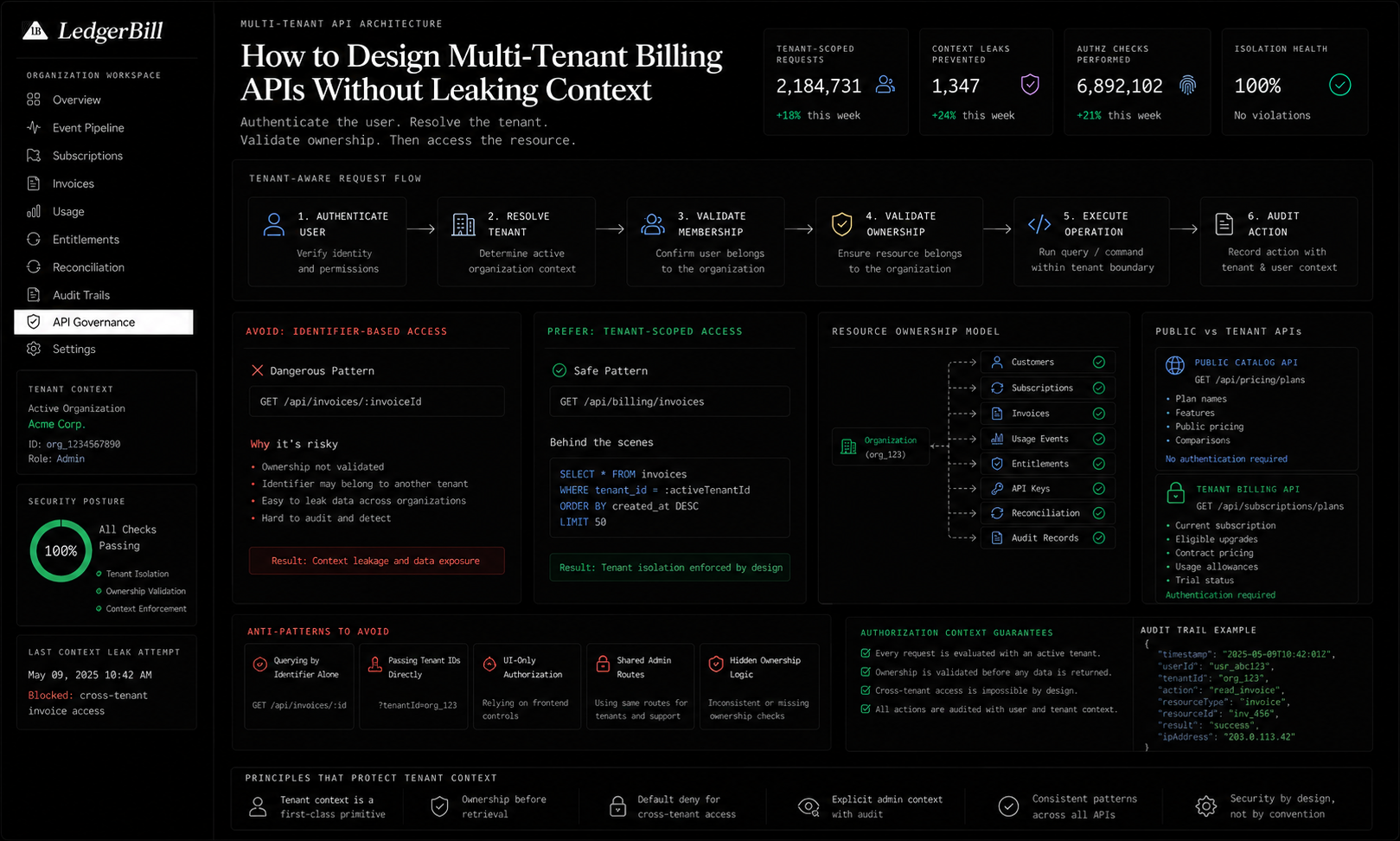
As SaaS platforms grow, subscriptions, invoices, usage records, entitlements, API keys, reconciliation findings, and audit events all become tenant-owned resources.
The moment tenant ownership becomes unclear, security risks emerge.
Most multi-tenant billing incidents do not occur because authentication failed.
They occur because context leaked.
A request was authenticated successfully but executed against the wrong organization.
That distinction matters.
Authentication answers:
Who is making the request?
Tenant isolation answers:
Which organization owns the resource?
The two are related, but they are not the same thing.
The Most Common Multi-Tenant Mistake
Many systems begin with routes that look like this:
GET /api/invoices/:invoiceId
The implementation retrieves the invoice and returns it.
At first glance, the route appears harmless.
The problem is that ownership is not part of the query.
The application is effectively asking:
Does this invoice exist?
Instead of:
Does this invoice belong to the active organization?
Those questions produce very different security outcomes.
Ownership Before Retrieval
Every billing request should establish organizational ownership before accessing data.
Conceptually:
Request
    ↓
Authenticate User
    ↓
Resolve Active Tenant
    ↓
Validate Ownership
    ↓
Execute Query
    ↓
Return Response
Ownership validation should occur before business logic executes.
Not after.
Not during serialization.
Not inside the UI.
At the API boundary.
Tenant Context Is a First-Class Primitive
Many applications treat tenant information as metadata.
Mature billing platforms treat tenant context as infrastructure.
Every resource should be associated with a tenant.
Examples include:
- Customers
- Subscriptions
- Invoices
- Usage events
- API keys
- Entitlements
- Reconciliation findings
- Audit records
- Webhook events
The ownership relationship should exist before any business process begins.
Without it, authorization becomes difficult to reason about.
Why Identifier-Based Access Is Dangerous
Developers often assume identifiers are sufficient.
For example:
GET /api/subscriptions/sub_123
or
GET /api/invoices/inv_456
The route appears secure because the identifiers are unique.
The problem is that uniqueness does not imply ownership.
An authenticated user may still access resources belonging to another tenant if ownership checks are not enforced.
This becomes especially dangerous when identifiers are:
- Exposed in URLs
- Logged externally
- Shared accidentally
- Referenced by integrations
The safer pattern is always tenant-aware access.
Prefer Tenant-Scoped Queries
Instead of:
GET /api/invoices/:invoiceId
prefer:
GET /api/billing/invoices
where tenant context is resolved automatically from authentication and organizational membership.
Internally, the query becomes:
WHERE tenant_id = ?
before any invoice lookup occurs.
This dramatically reduces accidental context leakage.
Designing Tenant-Aware Route Registries
As platforms grow, APIs often contain hundreds of routes.
A route registry becomes useful because it centralizes ownership metadata.
Instead of documenting authentication requirements informally, routes can declare their expected authorization posture.
Examples:
Public
Authenticated
Tenant Scoped
Administrative
System
This allows governance tooling to verify that sensitive billing routes cannot be exposed accidentally.
A route registry becomes more than documentation.
It becomes an enforcement mechanism.
Public APIs vs Tenant APIs
One useful pattern is separating public resources from tenant-owned resources.
For example:
Public Catalog
GET /api/pricing/plans
Contains:
- Plan names
- Features
- Public pricing
No tenant ownership required.
Tenant Billing
GET /api/subscriptions/plans
Contains:
- Current subscription
- Eligible upgrades
- Contract pricing
- Usage allowances
Tenant ownership required.
This separation prevents accidental exposure of customer-specific billing information.
The Authorization Layer Is Not Enough
A common anti-pattern looks like:
User Authenticated
      ↓
Access Granted
Authentication alone does not guarantee correct access.
A user may belong to multiple organizations.
A support engineer may have elevated privileges.
A service account may operate across tenants.
The platform still needs to answer:
Which tenant context applies to this request?
Without that answer, authorization decisions become ambiguous.
Tenant Isolation and Stripe
Stripe provides excellent customer and subscription management.
However, Stripe does not understand application-specific tenant relationships.
For example:
Stripe Customer
        ↓
Stripe Subscription
        ↓
LedgerBill Organization
        ↓
Users
        ↓
Entitlements
That organizational mapping exists inside the application.
Billing APIs must preserve this ownership chain throughout every request.
Otherwise, Stripe objects become disconnected from the tenant that owns them.
Multi-Tenant Support Workflows
Support tooling often introduces unique risks.
Engineers frequently create endpoints intended to help investigate customer issues.
Examples include:
GET /api/admin/invoices/:id
or
GET /api/admin/subscriptions/:id
Without clear separation between support operations and tenant operations, context leakage becomes increasingly likely.
Administrative access should be explicit, audited, and governed separately from tenant access.
Anti-Patterns to Avoid
Querying by Identifier Alone
GET /api/invoices/:id
without tenant validation.
Passing Tenant IDs Directly
GET /api/invoices?tenantId=123
without verifying membership.
UI-Only Authorization
Relying on frontend controls to restrict visibility.
Shared Administrative Routes
Using the same route for tenant access and support access.
Hidden Ownership Logic
Embedding ownership validation inconsistently across services.
Each of these patterns increases the likelihood of context leakage.
Recommended Pattern
A production-grade billing API should follow a predictable flow:
Authenticate
      ↓
Resolve Tenant
      ↓
Validate Membership
      ↓
Validate Ownership
      ↓
Execute Operation
      ↓
Audit Action
This creates a consistent security model across every billing surface.
Subscriptions.
Invoices.
Usage.
Entitlements.
Reconciliation.
Audit records.
Everything follows the same ownership rules.
Final Thoughts
The hardest problem in multi-tenant billing is not calculating charges.
It is preserving context.
Every invoice belongs to an organization.
Every subscription belongs to an organization.
Every entitlement belongs to an organization.
Every usage record belongs to an organization.
Successful billing platforms make that ownership relationship explicit throughout the entire API surface.
Because the safest multi-tenant APIs are not the ones with the most authorization logic.
They are the ones where ownership is impossible to forget.