The Hidden Cost of Plan Drift: How Pricing Inconsistency Breaks Trust
Most billing incidents do not start with an outage.
They start with a disagreement.
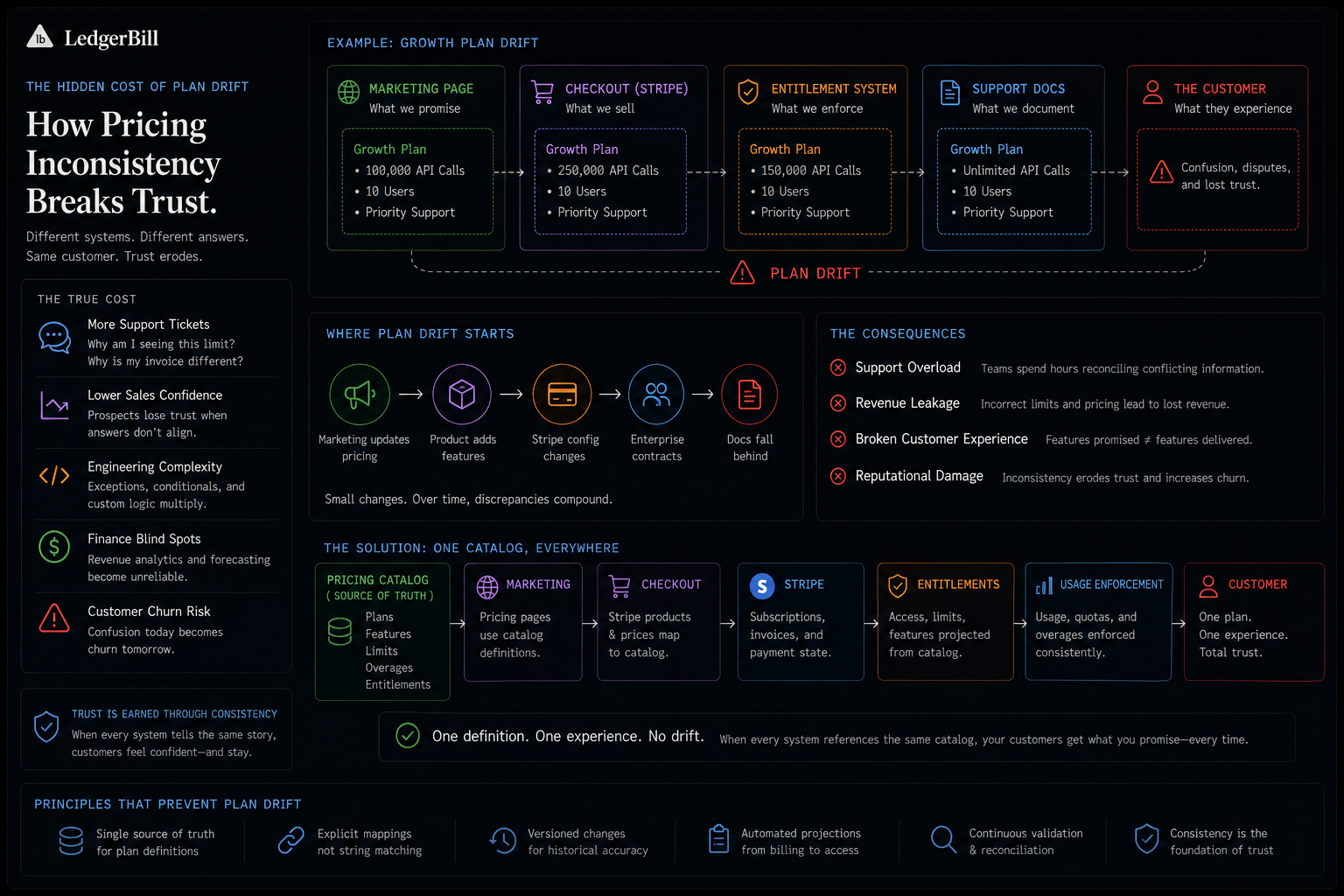
Marketing says a plan includes one limit.
Checkout sells another.
The application enforces a third.
Support references a fourth.
Finance sees a fifth.
No system appears obviously broken.
Yet the customer experiences something worse than downtime:
Confusion.
And confusion is expensive.
What Is Plan Drift?
Plan drift occurs when different parts of a platform have different interpretations of the same subscription plan.
For example, a company launches a Growth plan.
Marketing advertises:
100,000 API Calls
10 Users
Priority Support
Checkout is configured with:
250,000 API Calls
10 Users
Priority Support
The entitlement system enforces:
150,000 API Calls
Support documentation still references:
Unlimited API Calls
Technically, every team believes it is correct.
Operationally, the customer receives four different answers.
That is plan drift.
Why Plan Drift Is More Dangerous Than Bugs
A traditional software bug is usually visible.
The application crashes.
An error appears.
A service becomes unavailable.
Plan drift is subtler.
The platform continues functioning.
Invoices generate correctly.
Subscriptions renew.
Users log in.
The inconsistency often remains hidden until a customer asks a simple question:
What exactly did I buy?
At that moment, different systems begin providing different answers.
Trust starts to erode.
The Customer Sees One Product
Internally, organizations think in systems.
Customers do not.
Customers do not distinguish between:
- Pricing pages
- Stripe products
- Entitlement services
- Usage meters
- Billing databases
They see one product.
When one part of the product promises something that another part does not deliver, customers rarely blame architecture.
They blame the company.
Where Plan Drift Usually Starts
Plan drift often emerges gradually.
Marketing Updates Pricing
A pricing page changes.
Engineering is not notified.
Product Adds Features
New capabilities are introduced.
Entitlements remain unchanged.
Stripe Configuration Changes
Products and prices are updated.
Internal catalogs are not.
Enterprise Contracts Appear
Custom limits are added manually.
Support documentation falls behind.
Each change appears small.
Over time, the discrepancies accumulate.
The Operational Cost of Plan Drift
Many organizations underestimate the operational impact.
Support Burden Increases
Support teams spend time answering questions such as:
- Why am I seeing this limit?
- Why is my invoice different?
- Why is my usage restricted?
- Why can't I access this feature?
These are not product questions.
They are consistency questions.
Sales Becomes More Difficult
Prospective customers lose confidence when pricing information appears contradictory.
Enterprise buyers become especially sensitive to these inconsistencies.
Engineering Complexity Grows
Developers begin introducing exceptions:
if (customer.isLegacy) {
  ...
}

if (customer.isEnterprise) {
  ...
}
Business logic becomes increasingly difficult to reason about.
Finance Loses Visibility
When plan definitions diverge, revenue analysis becomes less reliable.
Teams struggle to answer:
Which customers actually belong to which plans?
Why Stripe Is Not the Problem
Stripe is frequently blamed for pricing complexity.
In reality, Stripe usually reflects the configuration it receives.
The underlying problem is often that organizations allow pricing definitions to exist in multiple places.
For example:
Marketing Site
       ↓
Checkout
       ↓
Stripe Products
       ↓
Entitlements
       ↓
Usage Enforcement
If each system maintains its own plan definitions, drift becomes inevitable.
The issue is not Stripe.
The issue is ownership.
The Pricing Catalog Solution
The most effective solution is establishing a centralized pricing catalog.
A pricing catalog should define:
- Plan names
- Plan identifiers
- Features
- Usage limits
- Overage rules
- Entitlement mappings
- Stripe product mappings
- Upgrade paths
Every billing-related surface should derive from that catalog.
The catalog becomes the source of truth.
One Definition, Many Consumers
A healthy architecture looks like:
Pricing Catalog
       ↓
Marketing
       ↓
Checkout
       ↓
Stripe Mapping
       ↓
Subscriptions
       ↓
Entitlements
       ↓
Usage Enforcement
Every consumer references the same plan definitions.
Changes occur once.
The entire platform remains aligned.
Why Entitlements Must Be Explicit
One of the most common contributors to plan drift is implicit entitlement logic.
For example:
if (planName.includes("growth")) {
  ...
}
This works until:
Growth
Growth Plus
Growth Annual
Growth Legacy
all exist simultaneously.
The system begins guessing.
Explicit plan mappings eliminate this ambiguity.
The platform stops inferring access and starts projecting access from known definitions.
Enterprise Plans Magnify the Problem
The challenge becomes more significant as companies move up-market.
Enterprise customers often introduce:
- Contract pricing
- Custom limits
- Legacy agreements
- Migration plans
- Private offerings
Without centralized governance, each exception becomes another source of drift.
Eventually every customer appears to be on a unique plan.
A catalog-driven model prevents this fragmentation.
Trust Is Built Through Consistency
Customers rarely inspect billing architecture.
They evaluate outcomes.
Trust grows when:
- Pricing pages match invoices.
- Invoices match subscriptions.
- Subscriptions match entitlements.
- Entitlements match enforcement.
Consistency creates confidence.
Confidence creates trust.
Trust reduces support burden and increases customer retention.
The LedgerBill Approach
LedgerBill treats pricing as operational infrastructure rather than marketing content.
Public pricing endpoints expose catalog definitions.
Subscription endpoints expose catalog definitions combined with tenant context.
Checkout references catalog mappings.
Entitlements derive from catalog rules.
Usage enforcement derives from catalog limits.
The objective is simple:
Every system should describe the same plan the same way.
When that principle is enforced consistently, plan drift becomes significantly less likely.
Final Thoughts
Most organizations think pricing challenges are revenue problems.
In reality, they are often consistency problems.
Customers do not lose trust because pricing changes.
They lose trust because different parts of the platform describe the same plan differently.
Plan drift creates confusion.
Confusion creates support tickets.
Support tickets create operational cost.
And operational cost ultimately becomes a trust problem.
The solution is not more documentation.
The solution is a single source of truth that governs how plans are marketed, sold, billed, and enforced.
Because the most valuable feature of any pricing model is not flexibility.
It is consistency.