From Usage Event to Invoice Line: A Practical Rating Decision Pipeline
Most usage-based billing systems appear simple on the surface.
A customer uses a service.
Usage is recorded.
An invoice is generated.
A charge appears.
In reality, several important decisions occur between the moment a usage event is received and the moment an invoice line is created.
Those decisions determine:
- Whether the event is billable
- Which pricing version applies
- Whether included units are consumed
- Whether overage charges apply
- How estimated charges are calculated
 * How invoice lines are ultimately produced
The quality of those decisions determines whether a billing system remains explainable, auditable, and trustworthy.
The Journey Begins With a Usage Event
Every usage-based billing system starts with a metered event.
For example:
{
  "organizationId": "org_123",
  "meter": "api_requests",
  "quantity": 1000,
  "timestamp": "2026-04-30T12:00:00Z"
}
A typical ingestion endpoint might look like:
POST /api/v1/usage
At this stage, the platform knows only one thing:
Usage occurred.
It does not yet know whether that usage creates revenue.
Metering Is Not Rating
One of the most important billing concepts is the distinction between metering and rating.
Metering
Answers:
What happened?
Examples:
- 1,000 API requests
- 5 GB stored
- 200 documents processed
- 50 workflow executions
Rating
Answers:
What is this usage worth?
The rating engine transforms operational activity into financial decisions.
This is where billing begins.
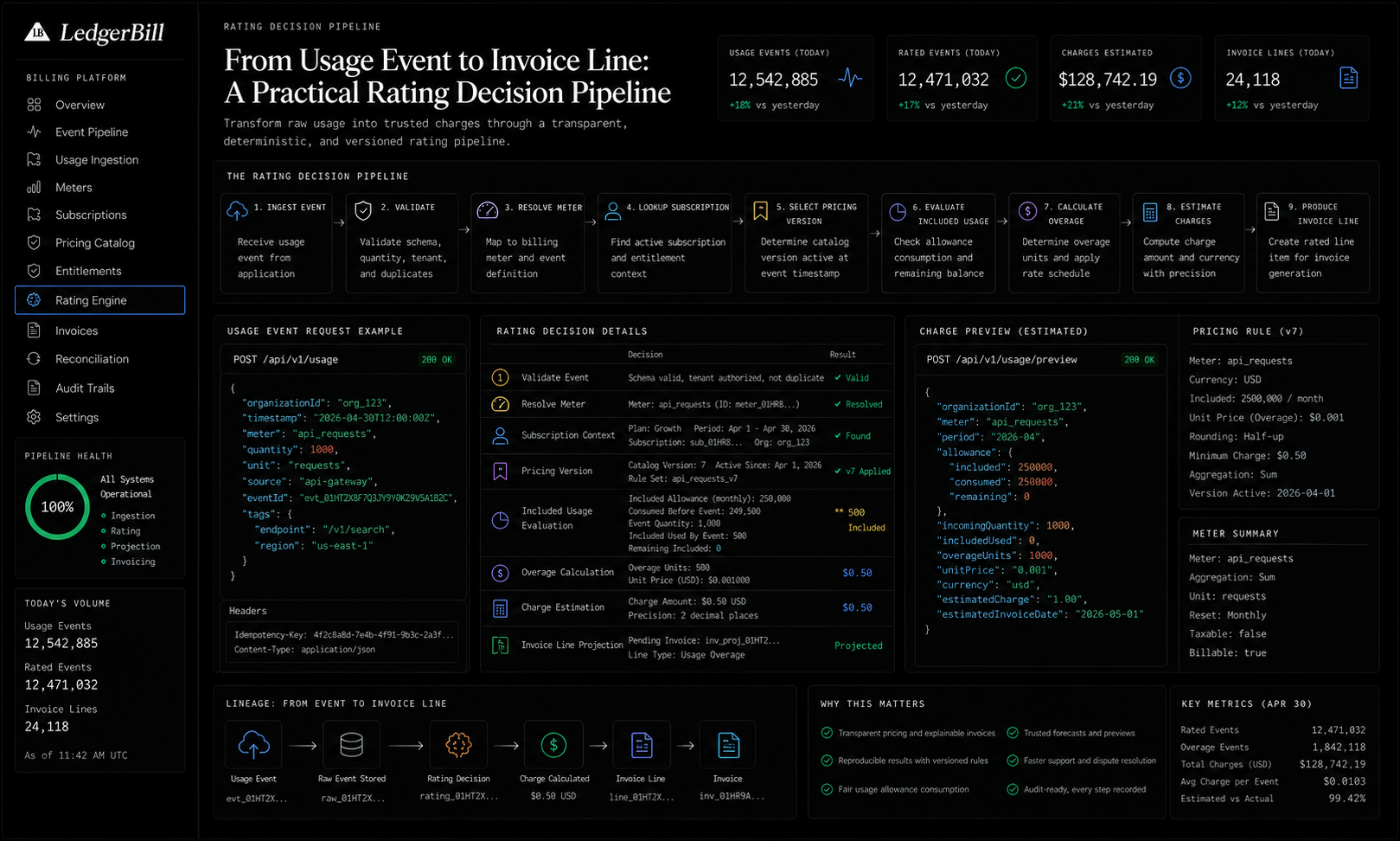
The Rating Decision Pipeline
A mature billing platform follows a predictable flow.
Usage Event
      ↓
Validation
      ↓
Meter Resolution
      ↓
Subscription Lookup
      ↓
Pricing Version Selection
      ↓
Included Usage Evaluation
      ↓
Overage Calculation
      ↓
Charge Estimation
      ↓
Invoice Projection
Each stage contributes to the final invoice outcome.
Step 1: Validate the Event
Before usage can be rated, the platform must verify that the event is valid.
Examples include:
- Organization exists
- Meter exists
- Quantity is valid
- Timestamp is valid
- Event is not duplicated
Invalid events should never reach the rating engine.
This creates a clean boundary between ingestion and billing.
Step 2: Resolve the Meter
The system next determines which billing meter applies.
Examples:
api_requests
storage_gb
documents_processed
workflow_runs
Each meter may have different pricing behavior.
The meter acts as the bridge between product activity and billing logic.
Step 3: Determine Subscription Context
Usage has no meaning without subscription context.
The rating engine must determine:
- Active subscription
- Current plan
- Billing period
- Entitlement configuration
- Pricing catalog version
For example:
Growth Plan
may include different allowances than:
Enterprise Plan
even when the same usage event is reported.
Step 4: Select the Pricing Version
This is one of the most overlooked aspects of billing.
Pricing changes over time.
For example:
Version 1
100,000 included units
$0.001 per overage unit
Later:
Version 2
250,000 included units
$0.0008 per overage unit
When evaluating historical usage, the platform must know:
Which pricing rules were active when this usage occurred?
This is why rating decisions should be versioned.
Without versioning, invoices become impossible to reproduce accurately.
Why Rating Versioning Matters
Consider a customer dispute six months later.
The customer asks:
Why was I charged this amount?
The answer requires more than usage history.
The platform must also know:
- Which catalog version applied
- Which rate schedule applied
- Which entitlement rules applied
Versioned rating decisions create reproducible billing outcomes.
A charge can always be recalculated from first principles.
Step 5: Evaluate Included Usage
Most SaaS plans include some amount of usage.
Examples:
Starter
10,000 API Requests Included
Growth
250,000 API Requests Included
The rating engine determines:
- Current consumption
- Remaining included units
- Units consumed by this event
For example:
Allowance: 250,000
Consumed: 249,500
Event: 1,000
Result:
500 Included
500 Overage
This decision becomes part of the rating record.
Step 6: Calculate Overage Units
Once included usage is exhausted, overage billing begins.
For example:
500 Overage Units
At this point the rating engine determines:
Overage Quantity × Unit Rate
Example:
500 × $0.001
Result:
$0.50
The invoice charge emerges from this calculation.
Step 7: Estimate Charges
Many modern billing platforms expose charge previews before invoices are generated.
Endpoints such as:
POST /api/v1/usage/preview
allow organizations to understand expected charges in advance.
This capability improves transparency by answering:
- What would this usage cost?
- How many included units remain?
- How much overage has accumulated?
- What is the projected invoice impact?
Preview APIs transform billing from a monthly surprise into a visible operational metric.
Why Charge Estimation Matters
Customers rarely complain about paying for usage they expected.
They complain about unexpected charges.
Charge estimation reduces uncertainty.
Engineering teams can:
- Test pricing changes
- Simulate workloads
- Forecast costs
Customers gain visibility into future invoices before billing cycles close.
Producing Invoice Lines
Eventually, rated usage must become invoiceable records.
For example:
Meter:
API Requests

Included Units:
250,000

Overage Units:
12,500

Rate:
$0.001

Charge:
$12.50
This information becomes an invoice line item.
The invoice is not created directly from raw events.
It is created from rating decisions.
That distinction matters.
Why Invoice Lineage Is Important
An invoice line should never appear without explanation.
The platform should be able to answer:
- Which usage events contributed?
- Which meter was used?
- Which pricing version applied?
- Which included units were consumed?
- Which overage units were billed?
This creates a complete lineage chain.
Usage Event
      ↓
Rating Decision
      ↓
Charge Calculation
      ↓
Invoice Line
Every charge becomes traceable.
The LedgerBill Approach
LedgerBill treats rating as a first-class billing capability rather than a mathematical afterthought.
Usage ingestion records activity.
The rating engine evaluates pricing rules.
Included allowances are consumed deterministically.
Overages are calculated transparently.
Preview endpoints expose projected charges before invoices are finalized.
Every rating decision can be traced back to:
- The original usage event
- The active subscription
- The pricing catalog version
- The entitlement configuration
- The resulting invoice line
This creates a billing system that is explainable, reproducible, and operationally trustworthy.
Final Thoughts
The hardest part of usage-based billing is not collecting usage.
It is turning usage into charges in a way that customers, support teams, finance teams, and engineers can all understand.
A well-designed rating pipeline provides that understanding.
Versioned pricing preserves historical accuracy.
Included usage protects customer expectations.
Overage calculations remain transparent.
Preview endpoints reduce surprises.
Invoice lineage explains outcomes.
Because the best billing systems do not simply generate charges.
They can explain exactly how every charge came to exist.