From Subscription to Access: How Entitlements Turn Billing Into Product Behavior
Completing checkout is not the end of the subscription journey.
It is the beginning.
A customer can successfully subscribe, provide payment details, and receive a paid invoice, but none of that automatically determines what they can do inside the product.
The platform still needs to answer a critical question:
What access should this organization have right now?
That is the role of entitlements.
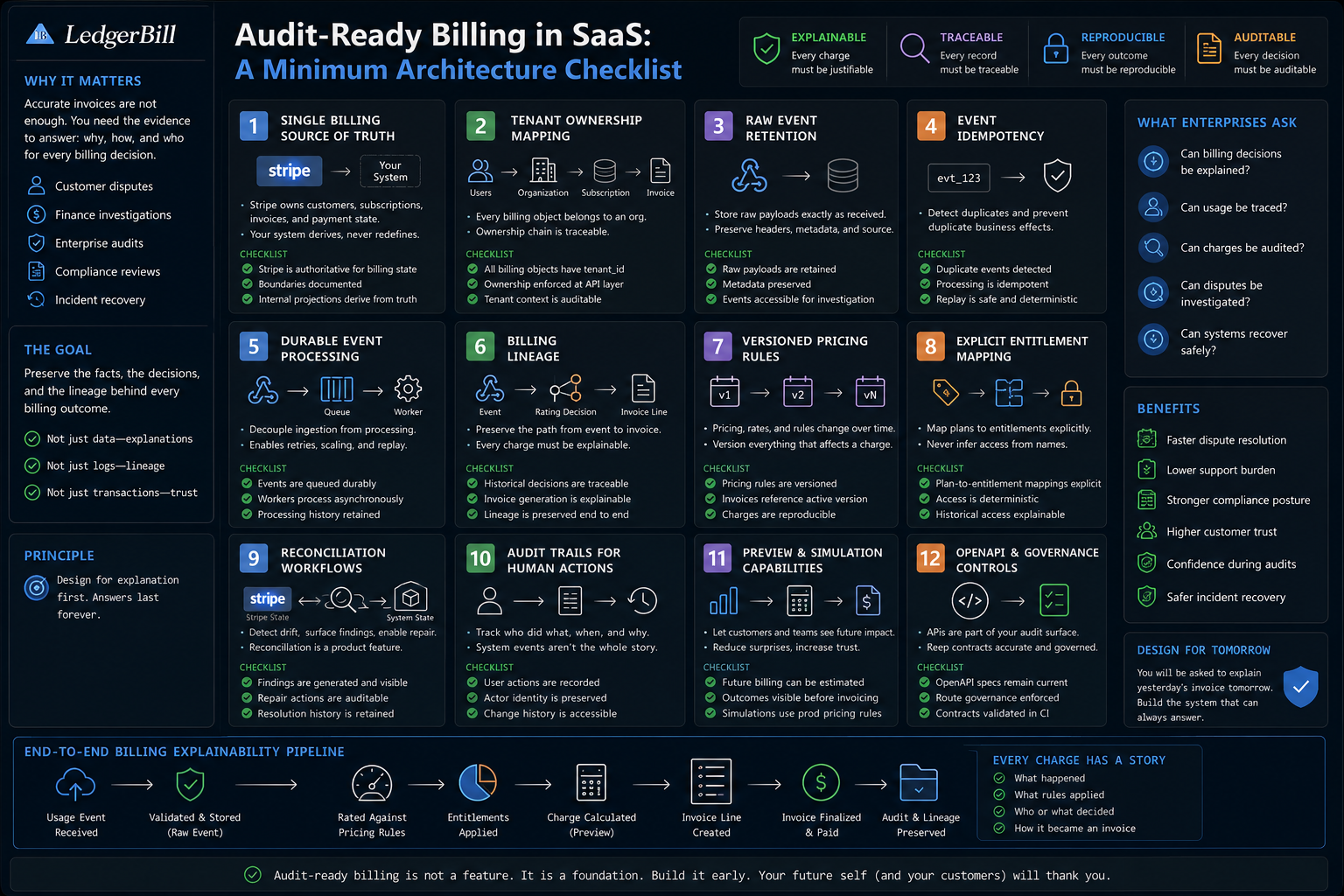
Modern SaaS products separate billing from access. Stripe manages subscriptions and payments, while the application projects that billing state into product capabilities, limits, and permissions.
Stripe Owns Billing State
Stripe is responsible for determining:
- Whether a subscription exists
- Which plan is active
- Whether payment succeeded
- Whether the subscription is trialing
- Whether the subscription is canceled
- When renewals occur
- When invoices are paid or fail
These decisions belong to Stripe.
Applications should avoid recreating subscription logic internally whenever possible.
Instead, they should consume Stripe's billing state and derive access from it.
This follows the architecture recommended by Stripe's subscription and SaaS billing documentation: Stripe manages subscription lifecycle events while applications react to those events and update internal systems accordingly.
Entitlements Are a Projection
Entitlements are not billing records.
They are a projection of billing records.
In LedgerBill, subscription state becomes operational access through an entitlement layer.
Examples include:
- Plan tier
- Included usage allowances
- Overage policies
- Feature availability
- Trial access
- Renewal state
- Organization status
- API limits
- User limits
- Access permissions
The entitlement system should never invent billing state.
Its responsibility is to translate subscription state into product behavior.
Conceptually:
Stripe Subscription
        ↓
Pricing Catalog
        ↓
Entitlement Projection
        ↓
Product Access
This creates a deterministic path from payment to access.
Why Pricing Catalogs Matter
Many subscription problems begin when pricing information becomes fragmented.
Marketing describes one plan.
Checkout sells another.
Documentation references different limits.
The application enforces something else entirely.
Customers do not see these systems separately.
They see one product.
When those systems disagree, trust is lost.
A pricing catalog solves this problem by creating a single source of truth for commercial definitions.
The catalog should define:
- Plans
- Features
- Usage allowances
- Overage rules
- User limits
- API limits
- Trial behavior
- Entitlement mappings
Every billing surface should reference the same catalog.
One Catalog, Many Consumers
A properly designed catalog becomes the foundation for multiple systems.
Marketing
Pricing pages display catalog data.
Checkout
Stripe products and prices reference catalog definitions.
Entitlements
Access rules derive from catalog definitions.
Usage Metering
Included quotas and overages originate from catalog limits.
Customer Portal
Upgrade and downgrade paths align with catalog offerings.
Support
Support teams can explain plan capabilities consistently.
This eliminates discrepancies between what is promised, what is sold, and what is delivered.
The Subscription Lifecycle
Subscription access is not static.
A customer's billing state evolves over time.
Examples include:
- Trial started
- Trial ended
- Subscription upgraded
- Subscription downgraded
- Invoice paid
- Payment failed
- Subscription paused
- Subscription canceled
- Subscription renewed
Each event affects access.
Rather than manually managing permissions, Stripe events should drive entitlement updates automatically.
For example:
Subscription Created
        ↓
Webhook Received
        ↓
Entitlements Projected
        ↓
Access Granted
Later:
Payment Failure
        ↓
Webhook Received
        ↓
Subscription State Updated
        ↓
Entitlements Recalculated
        ↓
Access Adjusted
This creates a predictable and auditable lifecycle.
Why Event-Driven Entitlements Matter
Stripe's architecture is fundamentally event-driven.
Subscriptions change over time, and applications are expected to react to those changes through webhooks.
An entitlement system built around webhook events provides several benefits:
Consistency
Access reflects actual billing state.
Automation
No manual intervention is required when subscriptions change.
Auditability
Every entitlement decision can be traced to a billing event.
Reliability
Access can be rebuilt from subscription history if needed.
The entitlement layer becomes a projection engine rather than a collection of manually managed permissions.
The Customer Experience
Customers should never need to understand subscriptions, webhooks, projections, or entitlement systems.
They should experience something much simpler.
- Sign up.
- Select a plan.
- Complete checkout.
- Return to the application.
- Receive the correct access.
If the subscription changes later, the application should update automatically.
If payment fails, access should reflect the updated subscription state.
If a customer upgrades, new capabilities should become available without manual intervention.
The entire process should feel seamless.
Billing as Product Infrastructure
The best subscription systems are largely invisible.
Customers do not think about entitlement projections.
They do not think about Stripe webhooks.
They do not think about pricing catalogs.
They simply expect the product to grant the correct access based on the plan they purchased.
That outcome requires a clear separation of responsibilities:
- Stripe owns billing truth.
- The pricing catalog defines commercial offerings.
- Entitlements translate billing into access.
- The application enforces those entitlements.
When those systems remain aligned, subscription billing feels less like an operational process and more like a natural part of the product experience.