Explainable Billing: Why Every Charge Needs a Story
Billing systems are often evaluated on a single metric: accuracy.
Did the customer receive the correct invoice?
Did the platform calculate the correct amount?
Did the payment succeed?
Those questions matter, but they are only part of the problem.
Modern billing systems must also be explainable.
When a customer asks:
Why was I charged?
The answer should not require searching logs, inspecting databases, or reconstructing events from memory.
The platform should be able to provide a complete and verifiable explanation.
Not a guess.
Not a best effort.
A timeline.
Beyond Current State
Most billing systems are built around mutable records.
A subscription table shows the current plan.
An invoice table shows the current invoice.
An entitlement table shows the current access level.
While useful, these tables only describe where the system ended up.
They do not explain how it got there.
Current state answers:
What is true now?
Customers, support teams, finance teams, and auditors often need a different answer:
What happened?
That distinction becomes increasingly important as billing systems grow more complex.
The Difference Between State and History
A mutable record captures the latest version of reality.
An event ledger captures the sequence of decisions that created it.
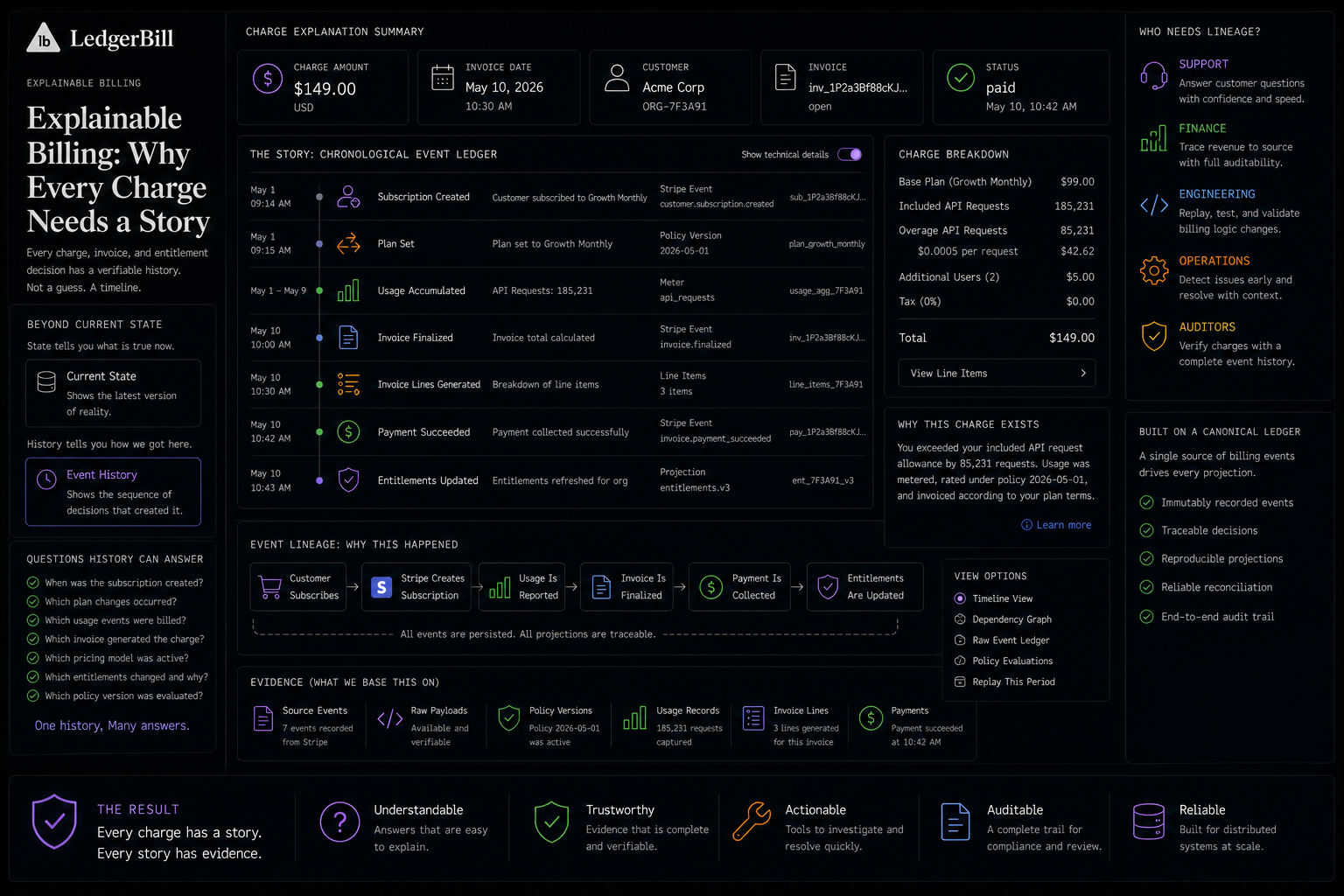
An event-based billing history can answer questions such as:
- When was the subscription created?
- When did the customer change plans?
- Which invoice generated the charge?
- Which usage events contributed to billing?
- Which pricing model was active at the time?
- Which entitlement decision granted or removed access?
- Which policy version evaluated the request?
Instead of showing only the outcome, the system preserves the journey.
That journey is often more valuable than the final number.
Why Support Teams Need Lineage
Most billing investigations begin with a customer question.
Examples include:
- Why was I billed more this month?
- Why was my access removed?
- Why does my invoice differ from last month?
- Why did my usage increase?
- Why was my subscription changed?
Without billing lineage, support teams are forced to manually reconstruct events across multiple systems.
With lineage, the answer already exists.
The platform can present:
Subscription Created
       ↓
Usage Reported
       ↓
Invoice Generated
       ↓
Payment Collected
       ↓
Entitlements Updated
Every decision becomes traceable.
Every outcome becomes explainable.
Why Finance Needs a Ledger
Financial systems are built on the principle that transactions should be traceable.
Billing should follow the same philosophy.
A canonical billing ledger provides:
- Historical accuracy
- Reconciliation support
- Auditability
- Revenue traceability
- Operational accountability
When finance teams review a charge, they should be able to follow its complete lineage back to the originating events.
This becomes especially important in usage-based billing systems where invoices may be influenced by thousands or millions of individual usage records.
Why Engineering Needs History
Engineering teams face a different challenge.
Billing logic evolves.
Pricing changes.
Policies change.
Entitlements change.
Metering rules change.
When business logic changes, teams need confidence that new behavior is correct.
Event-sourced billing enables teams to:
Replay Logic Safely
Run historical events through updated billing logic without modifying production records.
Compare Policy Versions
Understand how a previous pricing policy behaved compared to a new version.
Rebuild Projections
Regenerate invoices, entitlements, and reporting data from canonical events.
Validate Changes Before Deployment
Test new billing rules against historical production scenarios.
Rather than trusting assumptions, teams can evaluate behavior using real billing history.
From Black Box to Control Plane
Many billing systems operate like black boxes.
An invoice appears.
A charge occurs.
Access changes.
The reasoning exists somewhere, but it is difficult to discover.
Event-driven billing changes that model.
Every event becomes observable.
Every projection becomes traceable.
Every decision becomes explainable.
Instead of asking:
Why did this happen?
Teams can inspect the exact chain of events that produced the outcome.
The billing system becomes an operational control plane rather than a collection of disconnected records.
The Role of a Canonical Ledger
A canonical ledger serves as the foundation for explainable billing.
It provides a trusted sequence of events from which downstream systems derive state.
From that ledger, platforms can build:
- Invoice projections
- Entitlement projections
- Usage reports
- Audit records
- Reconciliation workflows
- Operational dashboards
The ledger becomes the shared source of evidence across engineering, finance, support, and operations.
Everyone works from the same history.
Everyone reaches the same conclusion.
Explainability Creates Trust
Customers trust billing systems when charges can be explained.
Support teams trust billing systems when answers are easy to find.
Finance teams trust billing systems when transactions can be traced.
Engineering teams trust billing systems when logic can be replayed and validated.
All of those outcomes depend on the same foundation:
Traceability.
Final Thoughts
Billing accuracy is essential.
But accuracy alone is not enough.
Modern billing systems must be able to explain how every invoice, entitlement decision, usage charge, and subscription change came to exist.
A canonical event ledger provides that explanation.
When every charge has a history, every decision has evidence, and every projection can be traced back to its source, billing becomes easier to audit, easier to operate, and easier to trust.
Because the best billing systems do more than calculate the right answer.
They can prove how they arrived at it.