Entitlements After Checkout: Deterministic Plan Mapping That Doesn't Drift
A customer completes checkout.
Stripe creates a subscription.
Payment succeeds.
The invoice is paid.
At that moment, one question becomes more important than any other:
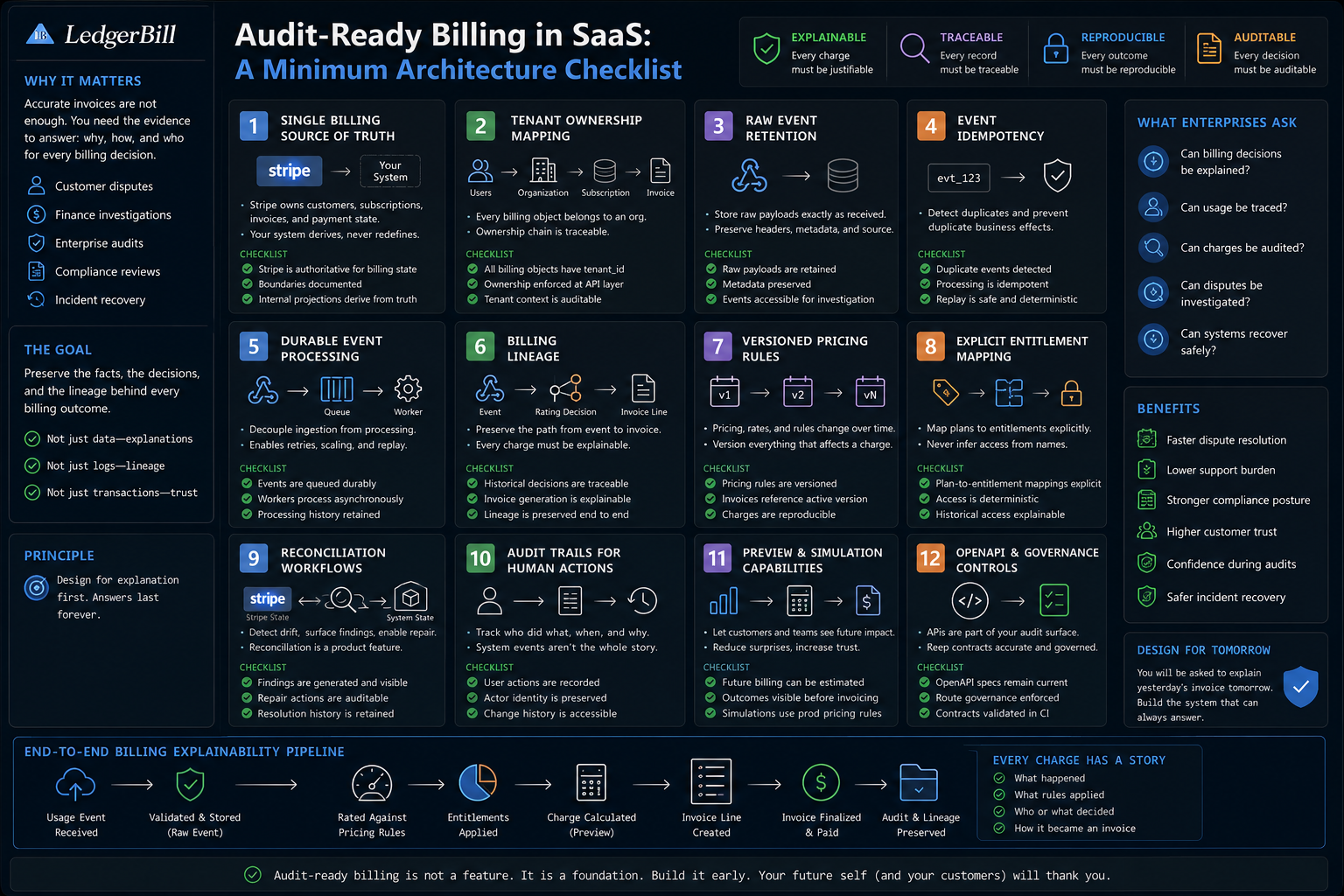
What should this organization be allowed to do?
The answer lives in the entitlement layer.
Unfortunately, many SaaS platforms treat entitlement mapping as an afterthought.
They build robust checkout flows, integrate Stripe correctly, and establish subscription lifecycle management—only to determine access using fragile logic such as:
if (planName.includes("pro")) {
  enableProFeatures();
}
or:
if (subscription.productName === "Growth") {
  maxProjects = 25;
}
These shortcuts work initially.
They rarely survive long-term product growth.
The Hidden Problem After Checkout
Stripe's responsibility ends with billing state.
Stripe can tell the application:
- Which customer subscribed
- Which price was purchased
- Which subscription is active
- Whether payment succeeded
- Whether renewal occurred
What Stripe does not determine is product behavior.
The application still needs to decide:
- Which features are enabled
- Which limits apply
- Which usage allowances exist
- Which APIs are available
- Which support level is granted
That translation layer is the entitlement system.
Why Entitlements Drift
Most entitlement failures occur because billing concepts and product concepts become loosely connected.
For example:
Marketing launches:
Growth Plan
Engineering maps:
growth
Stripe creates:
Growth Monthly
A later promotion introduces:
Growth Plus
Suddenly a simple rule becomes ambiguous:
if (planName.includes("growth"))
Which plan is being referenced?
The original Growth plan?
Growth Plus?
Growth Annual?
Growth Legacy?
The system begins relying on assumptions rather than definitions.
That is where drift starts.
The Problem With Substring Heuristics
String matching feels convenient.
It is also one of the most common sources of entitlement bugs.
Examples include:
plan.includes("starter")
plan.includes("enterprise")
plan.startsWith("growth")
These approaches assume naming conventions will remain stable forever.
In practice:
- Product names evolve.
- Marketing changes terminology.
- Legacy plans remain active.
- Enterprise contracts introduce exceptions.
- Regional pricing creates variants.
Eventually the entitlement system becomes dependent on naming rather than ownership.
Explicit Mapping Is Safer
Instead of deriving access from names, derive access from configuration.
A deterministic entitlement system should maintain explicit relationships between plans and capabilities.
Conceptually:
Stripe Price
        ↓
Plan Identifier
        ↓
Entitlement Definition
        ↓
Product Access
This removes ambiguity entirely.
The system no longer guesses.
It resolves.
Configuration as the Source of Truth
A configuration-driven approach allows entitlement definitions to exist independently from application logic.
For example:
{
  "starter": {
    "projects": 5,
    "users": 3
  },
  "growth": {
    "projects": 25,
    "users": 10
  },
  "enterprise": {
    "projects": -1,
    "users": -1
  }
}
This mirrors the intent behind configuration-driven entitlement models such as:
LEDGERBILL_PLAN_ENTITLEMENTS_JSON
The application consumes the mapping.
The mapping defines behavior.
The code remains stable even as pricing evolves.
Why Determinism Matters
A deterministic entitlement system guarantees:
The same subscription always produces the same access.
No guessing.
No string matching.
No fallback logic.
No hidden assumptions.
When an organization purchases a plan, entitlement projection becomes predictable and repeatable.
This consistency is essential for:
- Billing
- Support
- Auditing
- Revenue operations
- Customer trust
Stripe Products Are Not Entitlements
Another common mistake is treating Stripe products as the entitlement model.
Stripe products are billing artifacts.
They represent:
- Products
- Prices
- Subscription configuration
Applications need additional business context.
For example:
Growth Monthly
Growth Annual
Growth Legacy
may all map to:
Growth Entitlements
The entitlement layer should not care about billing variations.
It should care about capabilities.
Separating billing definitions from entitlement definitions creates a more stable architecture.
The Relationship Between Pricing and Entitlements
Pricing catalogs define commercial offerings.
Entitlement systems define product behavior.
The two should be connected, but not merged.
Conceptually:
Pricing Catalog
       ↓
Plan Definition
       ↓
Entitlement Mapping
       ↓
Feature Enforcement
Each layer owns a specific responsibility.
This prevents pricing changes from accidentally altering access rules.
Supporting Enterprise Growth
The need for explicit mappings becomes even more important with enterprise customers.
Enterprise plans frequently introduce:
- Custom limits
- Additional features
- Negotiated contracts
- Temporary migrations
- Legacy support agreements
String matching quickly becomes impossible to maintain.
Explicit mappings allow organizations to define behavior intentionally rather than relying on naming conventions.
Operational Benefits
Deterministic entitlement mapping provides several advantages.
Easier Auditing
Teams can explain why access was granted.
Easier Support
Support can inspect entitlement definitions directly.
Easier Testing
Mappings can be validated automatically.
Easier Migrations
Pricing changes do not require entitlement rewrites.
Easier Governance
Access rules become configuration rather than scattered business logic.
A Better Pattern
Avoid:
if (planName.includes("pro")) {
  enableAdvancedFeatures();
}
Avoid:
if (priceId.includes("growth")) {
  allowMoreUsage();
}
Prefer:
const entitlements = entitlementCatalog[planId];
where:
planId
        ↓
deterministic mapping
        ↓
entitlements
The application becomes easier to reason about and significantly harder to break.
The LedgerBill Approach
LedgerBill treats entitlement projection as a deterministic process.
Checkout establishes billing state.
Pricing plans define commercial offerings.
Explicit mappings connect plans to capabilities.
Configuration defines behavior.
Entitlements are projected from known definitions rather than inferred from strings.
This eliminates an entire category of drift that commonly appears as products evolve.
Final Thoughts
Most entitlement failures are not caused by billing errors.
They are caused by ambiguous mappings between billing state and product access.
Substring matching, naming conventions, and implicit assumptions eventually become operational liabilities.
Explicit mappings provide a safer alternative.
They create predictable access rules, reduce support burden, simplify audits, and make billing behavior easier to explain.
Because after checkout, the platform should never have to guess what a customer purchased.
It should know.