Build vs Buy in Billing Infrastructure: Lessons from LedgerBill's Architecture
Why the smartest billing architectures don't choose between build or buy—they choose both.
Every CTO eventually encounters the same question:
Should the billing system be built internally, or should Stripe handle everything?
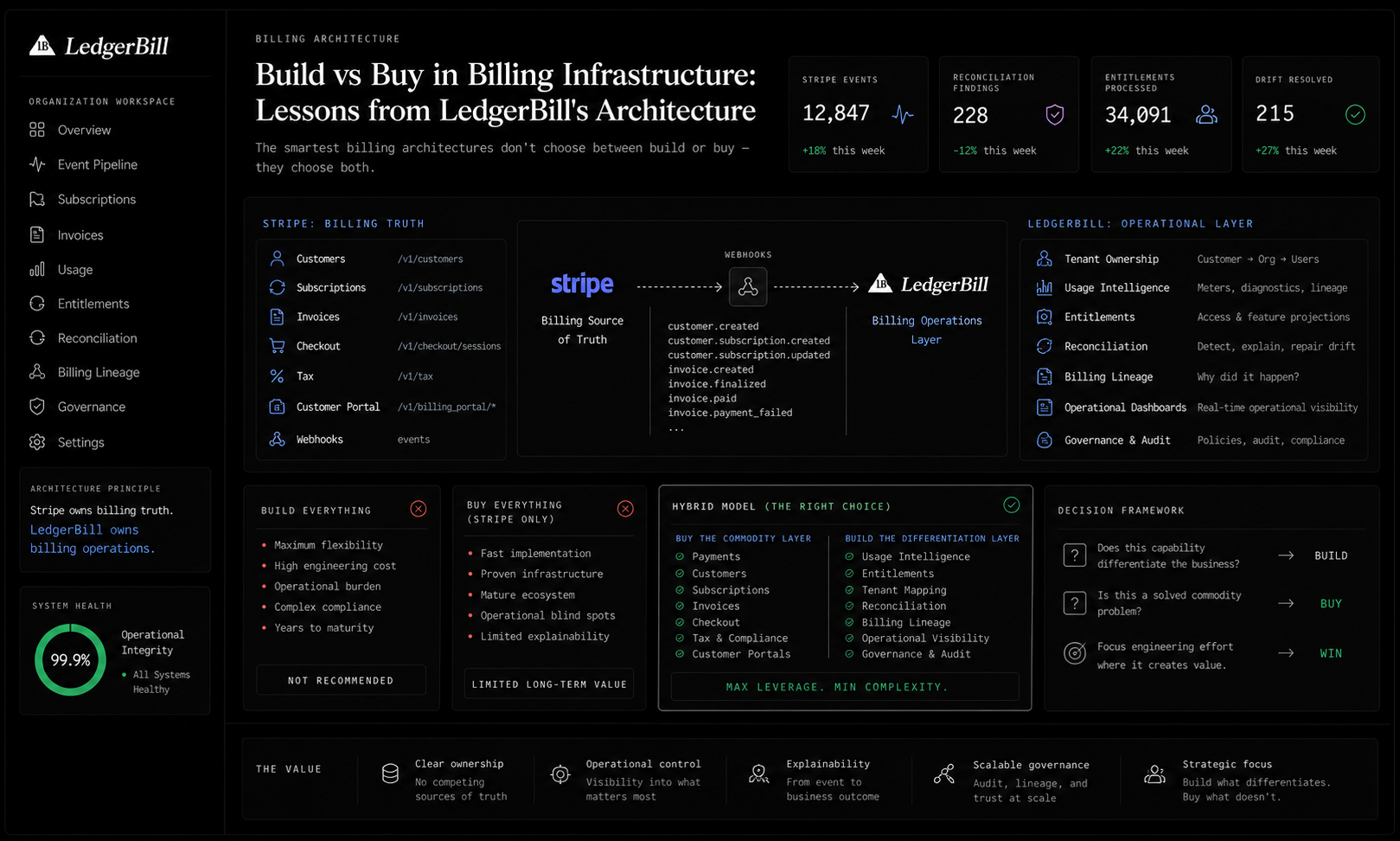
At first glance, the answer seems straightforward. Stripe already provides subscriptions, invoices, payment collection, tax support, customer portals, webhooks, metering capabilities, and a mature API ecosystem.
So why do companies continue investing millions of dollars into billing infrastructure?
Because billing and payments are not the same thing.
The most successful SaaS companies eventually discover that the real challenge is not collecting money. It is understanding, governing, explaining, and operationalizing the decisions behind that money.
That distinction sits at the heart of LedgerBill's architecture.
The False Choice
Most organizations approach billing as a binary decision:
Option A: Build Everything
Create:
- Subscription management
- Pricing catalogs
- Usage metering
- Invoice generation
- Payment processing
- Tax calculation
- Customer portals
- Reconciliation systems
This approach provides maximum flexibility but introduces enormous operational and compliance burden.
Option B: Buy Everything
Use Stripe Billing and treat it as the complete billing platform.
This dramatically accelerates implementation but often leaves engineering teams without visibility into the operational side of billing.
Both approaches miss a crucial reality.
The most scalable billing architectures separate billing execution from billing operations.
The System-of-Record Principle
One of the most important architectural decisions in any billing platform is defining ownership boundaries.
Without clear ownership, systems begin competing to answer the same questions.
For example:
- Is this subscription active?
- Has this invoice been paid?
- What plan is this customer on?
- Why was this entitlement granted?
If multiple systems answer those questions independently, drift becomes inevitable.
LedgerBill adopts a simple rule:
Stripe owns billing truth.
LedgerBill owns billing operations.
What Stripe Should Own
Stripe provides a mature API surface that already solves the hardest parts of payment infrastructure.
Examples include:
Customers
POST /v1/customers
GET /v1/customers/{id}
Customer records become the foundation of subscription ownership.
Subscriptions
POST /v1/subscriptions
GET /v1/subscriptions/{id}
Stripe manages:
- Subscription lifecycle
- Upgrades
- Downgrades
- Trials
- Renewals
- Cancellations
Invoices
GET /v1/invoices
GET /v1/invoices/{id}
Stripe owns invoice generation and payment collection.
Checkout
POST /v1/checkout/sessions
Stripe Checkout handles:
- Payment collection
- Payment method management
- Subscription activation
- Regulatory compliance
Webhooks
Stripe emits authoritative lifecycle events such as:
customer.created
customer.subscription.created
customer.subscription.updated
invoice.created
invoice.finalized
invoice.paid
invoice.payment_failed
These events become the canonical source of billing state.
For most SaaS companies, rebuilding these capabilities provides very little competitive advantage.
What Should Be Built
The question is not whether Stripe is sufficient.
The question is where Stripe stops.
This is where operational billing infrastructure begins.
Tenant Ownership
Stripe knows customers.
It does not know organizational ownership models inside the application.
A billing platform still needs to answer:
Stripe Customer
        ↓
Stripe Subscription
        ↓
Organization
        ↓
Users
        ↓
Entitlements
That mapping belongs inside the product.
Usage Visibility
Stripe can store usage records.
It does not explain them.
Engineering teams still need:
- Meter visibility
- Usage diagnostics
- Overage analysis
- Event lineage
- Operational dashboards
Entitlements
Stripe determines subscription state.
The application determines access.
For example:
Enterprise Plan
       ↓
500 Users
API Access
Audit Logs
Unlimited Projects
Those projections are product-specific and should remain under application control.
Reconciliation
Stripe can tell you the current state.
It cannot explain why internal projections differ from that state.
A reconciliation layer identifies:
- Projection failures
- Missing events
- Incorrect entitlements
- Drift between systems
This becomes increasingly important as organizations scale.
Lineage
Most billing systems answer:
What happened?
Few can answer:
Why did it happen?
A lineage system provides:
- Event history
- Projection history
- Replay history
- Invoice timelines
- Policy versions
This creates explainability across engineering, finance, support, and operations.
The Hybrid Model
LedgerBill follows what many mature SaaS companies eventually adopt:
Buy the Commodity Layer
Use Stripe for:
- Payments
- Customers
- Subscriptions
- Invoices
- Checkout
- Tax
- Customer portals
Build the Differentiation Layer
Use internal systems for:
- Usage intelligence
- Entitlements
- Tenant mapping
- Reconciliation
- Billing lineage
- Operational visibility
- Governance
- Auditability
This approach maximizes leverage while minimizing unnecessary complexity.
Why Full Replacements Often Fail
Many organizations begin by attempting to replace Stripe entirely.
The appeal is understandable.
A fully custom billing stack appears to offer:
- Complete control
- Unlimited flexibility
- Vendor independence
The reality is less attractive.
Engineering teams quickly inherit responsibility for:
- Tax regulations
- Payment method updates
- Compliance requirements
- Retry logic
- Subscription edge cases
- Regional payment behavior
- Invoice generation
Years of engineering effort are often spent recreating infrastructure that already exists.
Meanwhile, strategic capabilities remain unfinished.
Why Pure Stripe Architectures Eventually Struggle
The opposite extreme is equally problematic.
Organizations that rely exclusively on Stripe often discover operational blind spots.
Questions emerge:
- Why was a customer charged?
- Which usage events contributed?
- Which entitlement decision granted access?
- Which policy version created the invoice?
- Why do internal records differ from Stripe?
Stripe provides billing truth.
It does not provide organizational context.
That context must exist elsewhere.
A Decision Framework for CTOs
When evaluating build-versus-buy decisions, a useful question is:
Does this capability differentiate the business?
If the answer is no, buying is usually the correct decision.
Examples:
- Credit card processing
- Subscription management
- Invoice generation
- Tax calculations
- Customer payment portals
If the answer is yes, building often makes sense.
Examples:
- Usage intelligence
- Entitlement systems
- Auditability
- Governance
- Reconciliation workflows
- Revenue observability
- Customer-specific billing logic
The goal is not technical purity.
The goal is strategic allocation of engineering effort.
The LedgerBill Approach
LedgerBill was designed around a simple observation:
Most companies do not need another payment processor.
They need operational control over billing decisions.
Stripe remains the billing source of truth.
LedgerBill provides the visibility, lineage, reconciliation, governance, and entitlement infrastructure required to operate that billing system at scale.
The result is a hybrid architecture where every component owns a clearly defined responsibility.
Stripe answers:
What happened?
LedgerBill answers:
Why did it happen?
That distinction is where modern billing infrastructure creates value.
Final Thoughts
The build-versus-buy debate is often framed incorrectly.
The question is not whether to build billing or buy billing.
The question is which parts of billing create competitive advantage.
Payments, invoices, subscriptions, and tax calculations are solved problems.
Operational visibility, explainability, governance, reconciliation, and entitlement intelligence are not.
The most effective billing architectures buy the former and build the latter.
That is the architecture LedgerBill was designed to support.