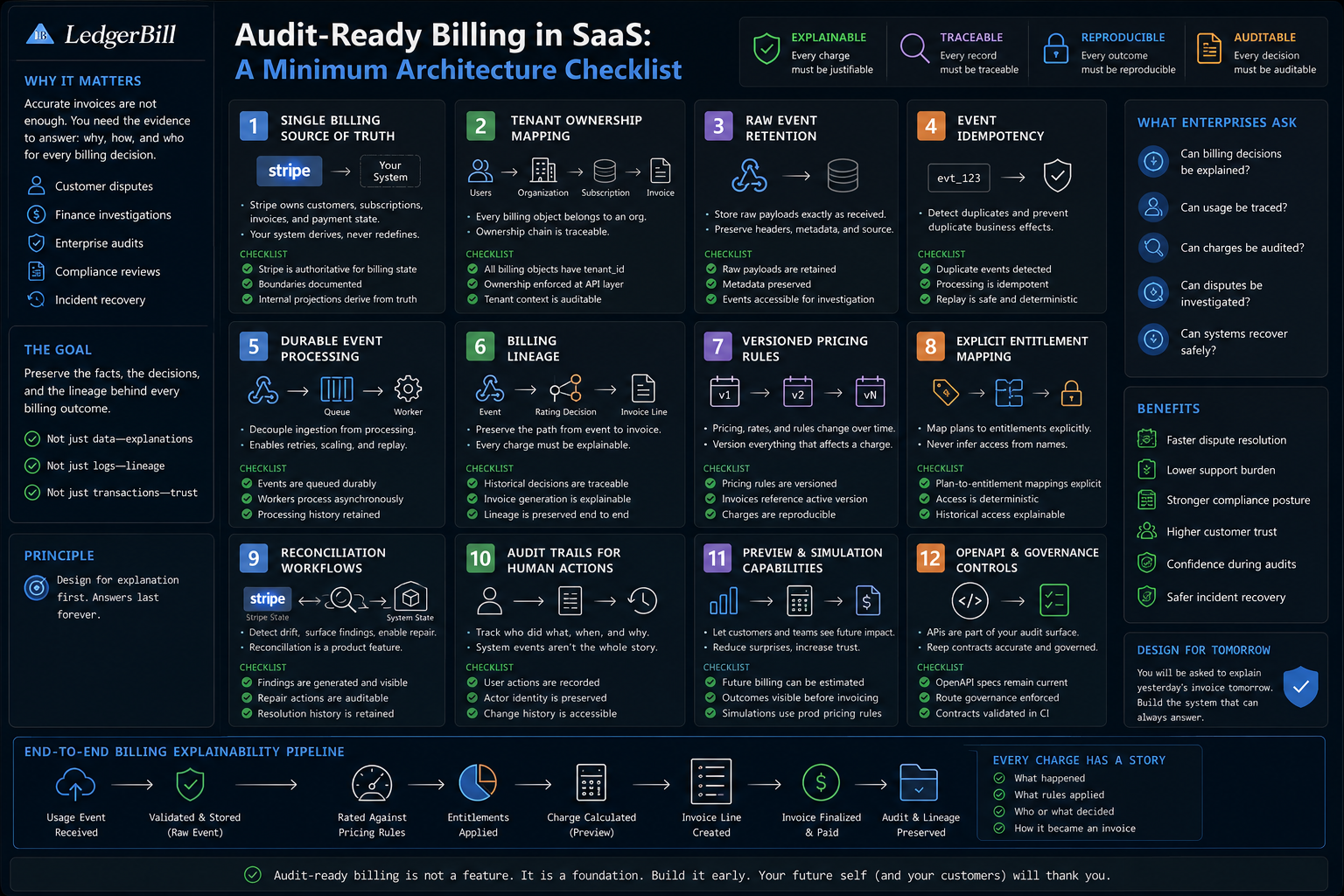
Audit-Ready Billing in SaaS: A Minimum Architecture Checklist
Most SaaS companies think about audits too late.
The typical trigger is not growth.
It is a problem.
A customer disputes an invoice.
Finance cannot explain a charge.
An enterprise prospect requests evidence.
A compliance review begins.
An internal investigation uncovers inconsistencies.
Suddenly, the organization needs answers.
Unfortunately, many billing systems were built to process transactions rather than explain them.
Those are very different goals.
A billing platform can be financially correct while remaining operationally opaque.
Modern SaaS organizations need more than accurate invoices.
They need audit-ready billing.
What Audit-Ready Actually Means
When people hear the word "audit," they often think about compliance frameworks.
While compliance matters, auditability is broader than regulation.
An audit-ready billing system can answer questions such as:
- Why was this customer charged?
- Which subscription generated this invoice?
- Which usage events contributed to the charge?
- Which pricing rules applied?
- Which employee changed the subscription?
- Which system generated the entitlement decision?
- What happened when a webhook failed?
- How was the issue repaired?
The goal is not simply preserving records.
The goal is preserving explanations.
The Cost of Missing Evidence
Most billing failures are not calculation failures.
They are evidence failures.
Organizations cannot answer:
Why did this happen?
When that occurs:
- Support escalations increase.
- Finance investigations become manual.
- Enterprise sales slow down.
- Customer trust declines.
The inability to explain a billing decision often becomes more damaging than the billing issue itself.
The Minimum Architecture Checklist
Audit-ready billing does not require enormous complexity.
It requires clear ownership and deliberate architecture.
The following capabilities form a practical baseline.
1. A Single Billing Source of Truth
Every billing platform must establish ownership boundaries.
For most SaaS companies:
Stripe
should own:
- Customers
- Subscriptions
- Invoices
- Payment state
The application should not attempt to independently redefine those concepts.
Without a clear source of truth, reconciliation becomes impossible.
Checklist
- Stripe is authoritative for subscription state.
- Billing ownership boundaries are documented.
- Internal projections derive from billing truth.
2. Tenant Ownership Mapping
Every billing record must belong to an organization.
Examples include:
- Subscriptions
- Invoices
- Usage events
- API keys
- Entitlements
- Audit records
The ownership chain should be traceable.
Conceptually:
Stripe Customer
       ↓
Subscription
       ↓
Organization
       ↓
Users
Checklist
- Every billing object has tenant ownership.
- Ownership is enforced at the API layer.
- Tenant context is auditable.
3. Raw Event Retention
Billing systems should preserve source events exactly as received.
Examples include:
- Stripe webhooks
- Usage submissions
- External billing events
Conceptually:
raw_source_events
The original evidence should remain available.
Checklist
- Raw payloads are retained.
- Metadata is preserved.
- Events remain accessible for investigation.
4. Event Idempotency
Duplicate processing creates audit problems quickly.
Platforms should track event identity.
For example:
stripe_event_ids
The same event should never create multiple business outcomes.
Checklist
- Duplicate events are detected.
- Processing is idempotent.
- Replay does not create duplicate side effects.
5. Durable Event Processing
Webhook handlers should not perform all work synchronously.
A safer architecture looks like:
Webhook
    ↓
Queue
    ↓
Worker
This creates resilience and replayability.
Checklist
- Events are queued durably.
- Workers operate asynchronously.
- Processing history is retained.
6. Billing Lineage
Current state is not enough.
Teams need historical context.
Billing lineage should answer:
- Which events occurred?
- Which projections were generated?
- Which decisions were made?
- Which invoice lines resulted?
Conceptually:
Event
   ↓
Rating Decision
   ↓
Invoice Line
Checklist
- Historical billing decisions are traceable.
- Invoice generation is explainable.
- Event lineage is preserved.
7. Versioned Pricing Rules
Pricing changes over time.
Auditability requires knowing which rules were active.
Examples include:
- Rate changes
- Plan updates
- Overage modifications
- Entitlement revisions
Checklist
- Pricing rules are versioned.
- Historical invoices reference historical rules.
- Charges remain reproducible.
8. Explicit Entitlement Mapping
Applications should never infer access through naming conventions.
Avoid:
plan.includes("pro")
Prefer:
Plan ID
    ↓
Entitlement Mapping
Checklist
- Plan-to-entitlement mappings are explicit.
- Feature access is deterministic.
- Historical access decisions are explainable.
9. Reconciliation Workflows
Billing systems drift.
The issue is not whether drift occurs.
The issue is whether it can be identified and repaired.
Checklist
- Reconciliation findings are generated.
- Differences are visible.
- Repair actions are auditable.
- Resolution history is retained.
10. Audit Trails for Human Actions
System events are only part of the story.
Human actions matter too.
Examples include:
- Subscription modifications
- Plan overrides
- Administrative repairs
- Entitlement adjustments
Checklist
- User actions are recorded.
- Actor identity is preserved.
- Change history remains accessible.
11. Preview and Simulation Capabilities
Customers increasingly expect visibility before billing occurs.
Preview systems improve transparency.
Examples include:
- Usage forecasts
- Overage estimation
- Invoice previews
- Upgrade impact analysis
Checklist
- Future billing can be estimated.
- Pricing outcomes are visible before invoicing.
- Simulations use production pricing rules.
12. OpenAPI and Governance Controls
Billing APIs become part of the audit surface.
Documentation should remain synchronized with implementation.
Checklist
- OpenAPI specifications remain current.
- Route governance is enforced.
- API contracts are validated in CI.
What Enterprise Customers Actually Evaluate
When enterprise customers assess billing systems, they rarely ask:
Can invoices be generated?
They assume the answer is yes.
More often they ask:
- Can billing decisions be explained?
- Can usage be traced?
- Can charges be audited?
- Can disputes be investigated?
- Can systems recover safely?
Auditability becomes a trust signal.
The LedgerBill Perspective
LedgerBill was designed around a simple observation:
Most billing platforms optimize for transaction processing.
Far fewer optimize for explainability.
An audit-ready architecture combines:
- Billing truth
- Tenant ownership
- Durable events
- Idempotency
- Lineage
- Reconciliation
- Governance
- Audit trails
Together these capabilities create a billing system that can answer difficult questions long after transactions occur.
Final Thoughts
Accurate billing is necessary.
Audit-ready billing is more demanding.
It requires a platform that preserves evidence, records decisions, tracks ownership, and explains outcomes.
The most valuable billing systems are not merely the ones that generate invoices correctly.
They are the ones that can prove why every invoice exists.
That is the foundation of trust in modern SaaS billing.